 DNAtest
Who Were the Anglo-Saxons? Are the English Descended From Them?
DNAtest360 earns a commission if you buy through links on this page.
For more than a century, historians argued about what happened in Britain after the Romans left. Did shiploads of Angles, Saxons and Jutes cross the North Sea and push the Britons west? Or did a small warrior elite arrive, and the locals simply adopt their language, dress and gods? The people who lived through it left almost no writing. Their bones, it turns out, kept the answer. Ancient DNA now shows that the truth was a real migration, a large one, and a great deal of mixing at the family level. It also shows how much of that North Sea ancestry is still carried by people in England today.
In short
- The Anglo-Saxons were migrants from the North Sea coast of today's northern Germany, the Netherlands and Denmark who settled in Britain from the 400s CE, together with the Britons they lived among.
- A 2022 study of 460 medieval genomes found a large-scale migration: some people buried in early medieval eastern England drew up to 76% of their ancestry from the continental North Sea zone.
- Migrants and Britons married and had families together, sometimes within a single generation.
- People in England today carry roughly 25% to 47% Anglo-Saxon-like ancestry, alongside older British ancestry and a large share related to Iron Age France.
Who were the Anglo-Saxons?
Roman rule in Britain ended around 410 CE. Over the next two centuries, people from across the North Sea settled in growing numbers in the east and south of the island. Writing about 300 years later, the Northumbrian monk Bede named them as three peoples: the Angles, the Saxons and the Jutes. He placed the Angles' homeland in Angeln, in today's Schleswig-Holstein, the Saxons' in what is now northern Germany, and the Jutes' in Jutland, and he told the legend of the brothers Hengist and Horsa, invited in as mercenaries, who turned on their hosts.
Historians treat Bede's neat three-way split, and his legends, with caution. Archaeology shows a shared culture all along the North Sea coast, from Jutland through Lower Saxony to Frisia, rather than three tidy tribes. What is not in doubt is the result. By about 600 CE, a new Old English-speaking culture dominated most of what would become England, divided into rival kingdoms such as Kent, Wessex, Mercia, East Anglia and Northumbria. The name "English" itself comes from the Angles, and Engla land, "land of the Angles", became England.
Ship burials, hoards and mead halls
The early Anglo-Saxons lived in small farming villages of timber halls and sunken-floored huts, raising cattle, sheep and pigs. They worshipped gods such as Woden and Thunor, who still give their names to Wednesday and Thursday. Lords kept their followers loyal with feasts and gifts in great mead halls, the world later sung about in the poem Beowulf.
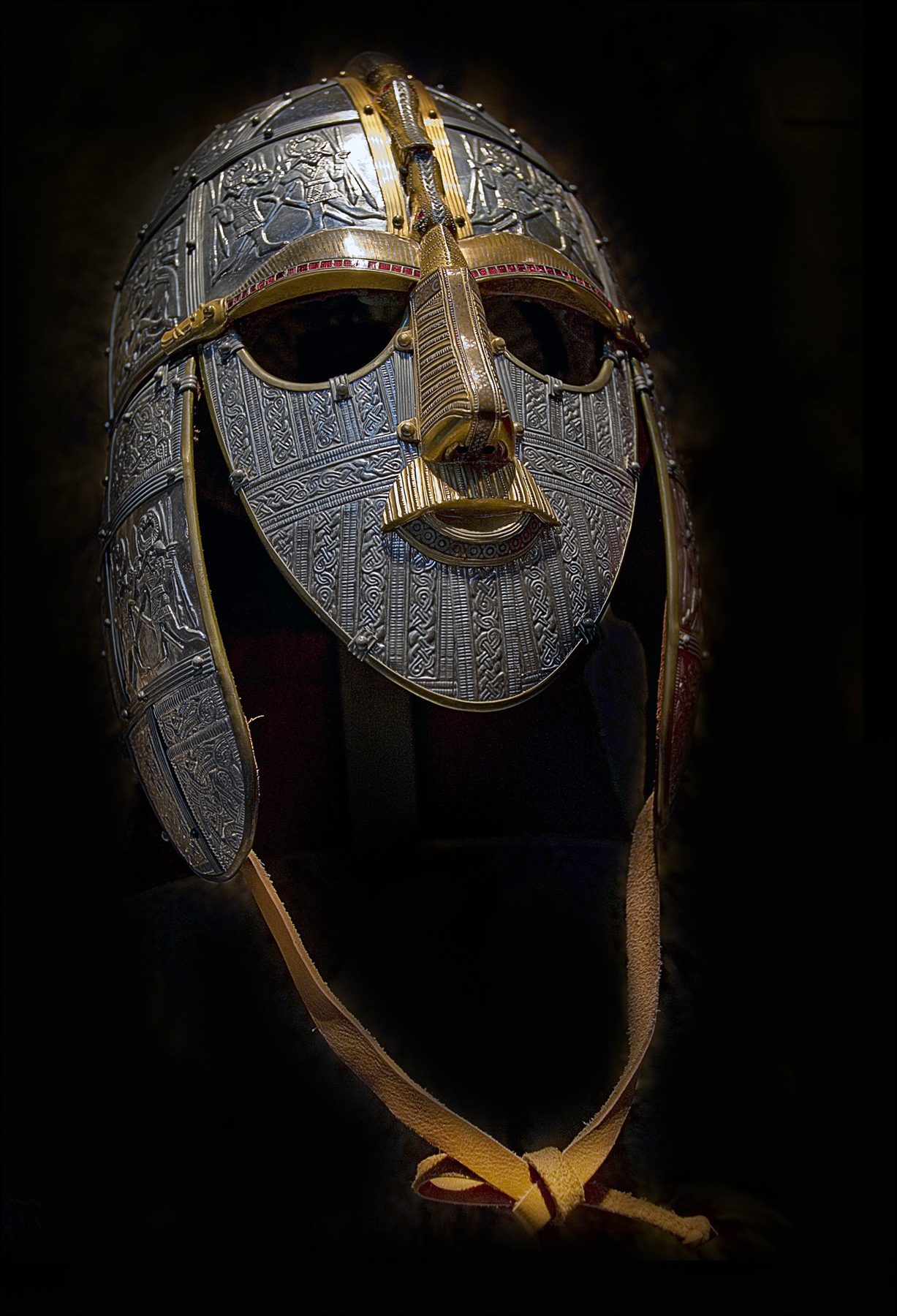
The most spectacular trace of that world was found in 1939 at Sutton Hoo in Suffolk. Under a mound lay the imprint of a ship about 27 metres long, packed with a king's treasures: the famous masked helmet, gold and garnet fittings, silver from the eastern Mediterranean. The man buried there may have been Rædwald, king of the East Angles, who died around 624, though no one can be sure. In 2009 a metal detectorist in Staffordshire found the Staffordshire Hoard, the largest hoard of Anglo-Saxon gold and silver ever discovered, mostly war-gear stripped from weapons.
Christianity arrived with missionaries from Rome in 597 and with Irish monks in the north. Monasteries such as Lindisfarne and Jarrow became centres of learning, where Bede finished his Ecclesiastical History of the English People in 731. Viking attacks from 793 shattered several kingdoms, but Wessex under Alfred the Great survived, and his grandson Æthelstan became the first king of all England in 927. The Anglo-Saxon age ended with the Norman conquest of 1066, but its language, its shires and many of its town names endure.
The great debate: invasion or a change of fashion?
The big question was always how many people came. Old English replaced the Britons' Celtic language and spoken Latin across most of England and borrowed very few words from them. To some scholars, that pointed to a mass migration that pushed the Britons aside. Others argued that a small, powerful incoming elite could have changed the culture without changing the population much, the way many peoples have adopted a ruling group's language.
Modern DNA alone couldn't settle it. A 2015 study of 2,039 people from rural parts of the UK whose grandparents were all born near one another found that the population of southeastern England carried a clear continental contribution, which the authors linked to the Anglo-Saxon migrations, but estimated it at under half. They also found that the Welsh, Cornish and Scots are not one shared "Celtic" population but several distinct groups. What was missing was DNA from the people of the time.
What the ancient genomes revealed
The first clue came in 2016. Stephan Schiffels and colleagues sequenced ten people buried near Cambridge, from the late Iron Age to the middle Anglo-Saxon period. The Anglo-Saxon-era people were closely related to today's Dutch and Danish. From them, the team estimated that people in the East of England today derive, on average, about 38% of their ancestry from the Anglo-Saxon migrations.
Then, in 2022, Joscha Gretzinger and a large team published genome-wide data from 460 medieval northwestern Europeans, including 278 people from England, many from early Anglo-Saxon cemeteries such as Dover Buckland, Apple Down, Oakington and West Heslerton. Their findings:
- It was a mass migration. Ancestry closely related to early medieval and present-day people of northern Germany and Denmark rose sharply in early medieval England. People analysed from eastern England derived up to 76% of their ancestry from this continental North Sea source, on average, with big differences between regions and even within the same cemetery.
- Migrants and Britons became families. At Dover Buckland in Kent, the team rebuilt a family tree across several generations. It began with relatives of entirely continental ancestry. Then a woman of fully local British ancestry married in, and her daughters were of mixed ancestry. Another generation later, more local ancestry entered and the grandchildren were roughly half and half. Brooches and weapons appear on both sides of the family.
- Culture didn't follow blood neatly. Women with migrant ancestry were more often buried with grave goods, especially brooches, than women with local ancestry. But men buried with weapons were just as likely to be of local ancestry as of migrant ancestry. Some Britons were buried as full members of the new "Anglo-Saxon" world.
So both old camps were partly right. There was a large movement of people, including many women and families, not just a warband. And there was no clean replacement: the newcomers and the Britons mixed, and their descendants became the English.
Are the English descended from the Anglo-Saxons?
Partly, and substantially. Comparing the ancient genomes with modern people, Gretzinger's team estimated that present-day English ancestry is:
- 25% to 47% like the early medieval North Sea migrants (the "Anglo-Saxon" component), peaking in southeastern, eastern and central England, especially Sussex, the East Midlands and East Anglia;
- 11% to 57% like the Iron Age people of Britain, the Britons who were already there;
- 14% to 43% like Iron Age people of France, a component that later events added, found in England but not in Wales, Scotland or Ireland, and as high as 43% in East Anglia.
Where that third, French-related ingredient came from is still being worked out. The study found it already present in some early medieval cemeteries in southeastern England, and it grew afterward. Several later movements across the Channel could have contributed, so it shouldn't simply be labelled "Norman". Anglo-Saxon-like ancestry is lower in southwestern and northwestern England and along the Welsh border. Most people in Scotland, Wales and Ireland today carry little or no continental contribution of this kind, as our Celtic DNA guide explains.
One caution matters. The Anglo-Saxon migrants were themselves a mix of the same ancient ingredients as everyone else in northern Europe: hunter-gatherers, Anatolian farmers and steppe herders. "Anglo-Saxon ancestry" is a recent layer on a very old cake, not a separate kind of DNA.
Can a DNA test show Anglo-Saxon ancestry?
Not directly, but it can give real clues.
- Ethnicity estimates. AncestryDNA and MyHeritage can't label any part of your DNA "Anglo-Saxon". The Anglo-Saxon migrants were genetically very close to today's northern Germans, Dutch and Danes, so English people often see small "Germanic Europe" or "Scandinavian" percentages. Those can reflect Anglo-Saxon or Viking-era ancestry, later migration, or simple statistical overlap between closely related neighbours. They're a hint, not proof.
- Paternal and maternal lines. Your haplogroups trace single lines back thousands of years. Haplogroup I1 was carried by many North Sea migrants and is rarer among Iron Age Britons, so an English I1 line plausibly arrived with Anglo-Saxons or later with Vikings. Most English men carry R1b, which was common on both sides of the North Sea, so only a deep branch can hint at which side. Remember that each line is one ancestor among thousands. See what your haplogroup means.
- Ancient genome matches. The most direct comparison is your DNA against the actual people buried in Anglo-Saxon cemeteries. That shows how closely you resemble them, not that any of them is your ancestor.
Already have a raw DNA file from 23andMe, AncestryDNA, MyHeritage or FamilyTreeDNA? (Here's how to download it.) Our free analyzer compares it with thousands of ancient genomes, including early medieval people from England and the North Sea coast, and shows which ancient people carried your maternal and paternal lines.
Already have a 23andMe, AncestryDNA or MyHeritage file? Open it in our free analyzer. It runs entirely in your browser, and your DNA is never uploaded.
Try the free analyzerIt runs in your browser, so your DNA file is never uploaded. Haven't tested yet? For British family history and matching with relatives, AncestryDNA has the largest database. To pin a paternal line to a precise branch, FamilyTreeDNA's Y-DNA tests go deepest. Not sure which fits? Take our 30-second quiz.
Frequently asked questions
Where did the Anglo-Saxons come from?
From the North Sea coast of continental Europe: today's northern Germany (Schleswig-Holstein and Lower Saxony), the northern Netherlands (Frisia) and Denmark. Ancient DNA shows the migrants to England were genetically closest to early medieval people from northern Germany and Denmark.
How much Anglo-Saxon DNA do the English have?
The 2022 study estimated 25% to 47% Anglo-Saxon-like ancestry in present-day English people, highest in the south, east and centre of England and lowest in the southwest, northwest and along the Welsh border. An earlier study estimated about 38% for the East of England.
Did the Anglo-Saxons wipe out the Britons?
No. DNA shows a large migration but not a replacement. Migrants and Britons married and had children together, and Britons were sometimes buried in the same style as the newcomers. Iron Age British ancestry is still a major part of English ancestry today.
Are the Anglo-Saxons and the Vikings the same people?
No, though they were related. The Anglo-Saxons arrived from the 400s onward and became the English. The Vikings were Scandinavians who raided and settled in England from the late 700s, centuries later. Their ancestry is similar enough that tests often can't tell them apart. See our Viking DNA guide.
Sources
- Gretzinger et al. 2022, "The Anglo-Saxon migration and the formation of the early English gene pool," Nature
- Schiffels et al. 2016, "Iron Age and Anglo-Saxon genomes from East England reveal British migration history," Nature Communications
- Leslie et al. 2015, "The fine-scale genetic structure of the British population," Nature
- Wikipedia, "Anglo-Saxons"
- Wikipedia, "Sutton Hoo"
- Wikipedia, "Staffordshire Hoard"