 DNAtest
Am I Descended From the Celts? Celtic DNA Explained
DNAtest360 earns a commission if you buy through links on this page.
Gold torcs, druids, hillforts, warriors who sacked Rome: the Celts are among the most romantic peoples of ancient Europe, and millions of people with Irish, Scottish, Welsh, Breton or French roots wonder whether they descend from them. Ancient DNA now gives a clearer answer than legend ever could, and it is more interesting than a simple yes or no.
In short
- "Celtic" is a family of languages and cultures, not a genetic group. There is no single Celtic gene or DNA signature.
- Ancient genomes show that much of the ancestry of Ireland and Britain was in place by the Bronze Age, well before Celtic-speaking cultures are recorded there.
- The great Iron Age Celtic cultures of the continent spread mostly through trade, ideas and marriage, not mass migration.
- If your family comes from Ireland, Scotland, Wales, Brittany or France, you very likely carry ancestry from the peoples who spoke Celtic languages, along with ancestry much older than them.
Who were the Celts?
Greek writers of the 6th and 5th centuries BCE called certain peoples beyond the Alps Keltoi. Romans later knew their cousins in France as Galli, the Gauls. These peoples spoke languages of the Celtic family, a branch of the Indo-European languages whose modern survivors are Irish, Scottish Gaelic, Manx, Welsh, Cornish and Breton.
Archaeologists link the continental Celts with two great Iron Age cultures:
- Hallstatt (about 800–450 BCE), named for a cemetery above a salt mine in the Austrian Alps. Its chiefs were buried with wagons, gold and Greek wine vessels, as at Hochdorf in Germany and Vix in France.
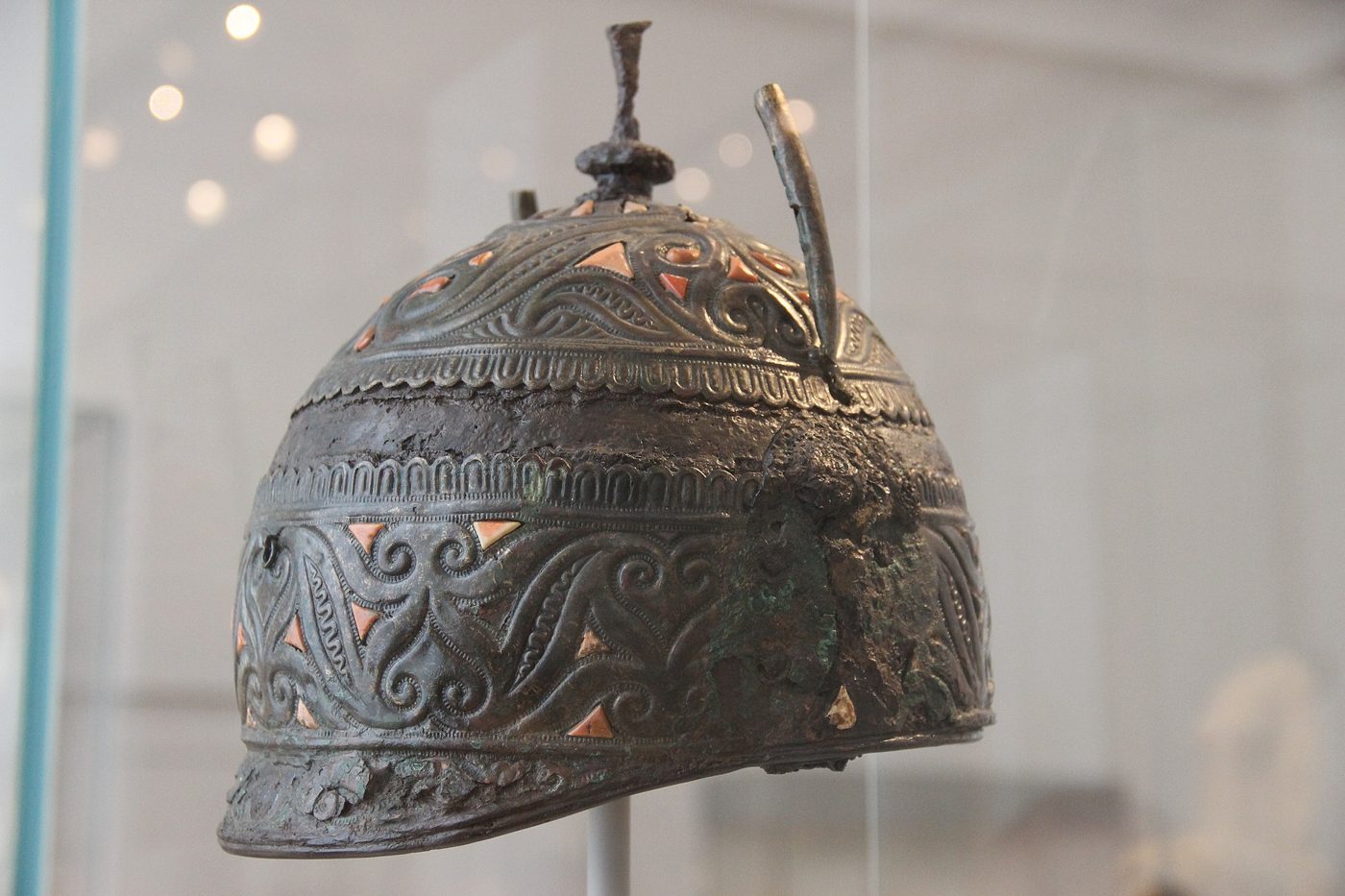
- La Tène (from about 450 BCE), named for a lakeside site in Switzerland. Its artists turned plants and animals into the swirling patterns that most people now call "Celtic art", on swords, shields, brooches and gold neck-rings.
At their height, Celtic-speaking peoples lived from Ireland and Iberia to the Danube, and one group, the Galatians, settled as far away as central Anatolia. Gauls sacked Rome around 390 BCE and raided the sanctuary of Delphi in 279 BCE. Julius Caesar's conquest of Gaul between 58 and 50 BCE began the long decline of the continental Celtic languages, which survived only on Europe's Atlantic edge.
Is there such a thing as Celtic DNA?
Not in the way the phrase is usually meant. "Celtic" describes the languages people spoke and the art and customs they shared. Language and culture can spread from neighbor to neighbor without many people moving, and a people can switch languages while their ancestry stays the same.
A large study of the modern British population makes the point well. In 2015, Leslie and colleagues compared the DNA of more than 2,000 people whose grandparents all lived in the same rural area. The parts of Britain where Celtic languages survived longest, such as Wales, Cornwall and Scotland, did not form one shared genetic group. Several of them were among the most genetically distinct regions of Britain, and they differed clearly from one another.
So the honest question isn't "do I have Celtic DNA?" but "do I descend from the people who lived in Celtic-speaking lands?" For many people with roots in northwest Europe, the answer is yes.
What ancient DNA reveals about the Irish
Irish medieval legend told that the Gaels arrived from Spain as the Sons of Míl, the last of a series of invasions. Genetics tells a different, deeper story.
In 2016, Cassidy and colleagues sequenced the genomes of a woman buried at Ballynahatty near Belfast around 3300 BCE and of three men buried on Rathlin Island, off County Antrim, between about 2000 and 1500 BCE. Her ancestry was mostly that of Europe's first farmers. The Rathlin men were different: they carried substantial steppe ancestry, which had reached Ireland with the arrival of metalworking. Their genomes are closest to people living in Ireland, Scotland and Wales today.
In other words, much of the island's ancestry was in place about 4,000 years ago, centuries before anyone wrote down a word of Irish. The Bronze Age Irish mined copper at Ross Island in Kerry and made some of the finest gold-work in prehistoric Europe. Whatever language they spoke, their descendants are still there.
What ancient DNA reveals about Britain
Britain's story has more chapters. Each left a mark you may still carry:
- About 2450 BCE: people of the Bell Beaker culture, carrying steppe-related ancestry, arrived from the continent. Within a few centuries about 90% of the gene pool of the earlier Stonehenge-building farmers had been replaced (Olalde et al. 2018).
- About 1000–875 BCE: a large movement of people related to those of ancient France reached southern Britain, but not Scotland. By some estimates it contributed around half the ancestry of later Iron Age people in England and Wales. The researchers suggest it is a plausible route for early Celtic languages into Britain (Patterson et al. 2022).
- The Iron Age: Britain then largely followed its own genetic path, with little further continental input except along parts of the south coast. The same research found cemeteries organized around female lines of descent, with husbands apparently marrying into their wives' communities (Cassidy et al. 2025).
- After Rome: Anglo-Saxon migrations from the 5th century added substantial new ancestry in what became England, much less in Wales, Cornwall and most of Scotland. Later came Norse settlers in the north and west, as our Viking DNA guide explains.
That's why someone from Wales or the Scottish Highlands today often has more ancestry from Iron Age Britons than someone from eastern England, though everyone in Britain carries a mix.
What about the Gauls and continental Celts?
For a long time, historians pictured Celtic peoples spreading out from a central European homeland in great waves of conquest. Ancient DNA has softened that picture. Genomes from Iron Age France studied by Fischer and colleagues (2022) show strong continuity with the Bronze Age people who lived there before, and close genetic similarity among regions with different archaeological cultures. The spread of La Tène style looks more like the spread of fashion, trade and marriage ties than the replacement of one people by another.
Where Celtic languages first arose is still debated. Some scholars favor central Europe and the Hallstatt world, others the Atlantic coast, and the Patterson study adds weight to a Bronze Age spread from France into Britain. The genetic evidence doesn't settle it, but it makes clear that the people of Gaul were largely descended from the people who had lived there for many centuries before.
Today, ancestry related to these Iron Age peoples is widespread in France, Belgium, Switzerland, Britain, Ireland and parts of Spain and northern Italy. If your roots are there, the Celts are part of your story, along with the farmers and hunter-gatherers who came before them.
Do you carry their DNA? What a test can show
No DNA test can tell you that you are "Celtic", and no honest one claims to. Here is what each kind of result can actually show:
- Ethnicity estimates from AncestryDNA, 23andMe and MyHeritage compare you with people living today. A high "Ireland", "Scotland" or "Wales" result means your DNA resembles people in those places now, whose ancestors include Bronze and Iron Age peoples. It's a good clue, not proof of a Celtic-speaking ancestor.
- Your paternal haplogroup. The branch of R1b called L21 is the most common paternal line in Ireland and is frequent in Scotland, Wales and Brittany. It's sometimes called a "Celtic" lineage, but it is older than any recorded Celtic language. It spread with the steppe-descended peoples of the Beaker era, so it tells you about deep Atlantic roots rather than about Celts as such. Other R1b branches, such as DF27 (common in Iberia and France) and U152 (common around the Alps and northern Italy), also occur in Celtic-speaking lands.
- Your maternal haplogroup traces your mother's mother's line. Most western European maternal lineages, such as H, U5 and K, are older than the Celts and found across the continent.
- Comparison with ancient genomes. This is the most direct test: matching your DNA against people actually buried in Iron Age Britain, Ireland and Gaul.
Our free analyzer compares your raw DNA file with more than 16,000 ancient individuals and shows which ancient people carried your maternal and paternal lineages, including Iron Age Celts and Britons and Bronze Age Ireland where they match. It runs entirely in your browser, so your file is never uploaded.
Already have a 23andMe, AncestryDNA or MyHeritage file? Open it in our free analyzer. It runs entirely in your browser, and your DNA is never uploaded.
Try the free analyzerHaven't tested yet? For Irish, Scottish or Welsh roots, AncestryDNA has the largest database and the finest regional breakdown for Britain and Ireland, which helps if you want to trace a family to a county. To place your direct paternal line on a precise branch of R1b, a FamilyTreeDNA Y-DNA test goes much deeper than the main kits. Not sure which fits? Take our 30-second quiz.
Frequently asked questions
Are the Irish Celts genetically?
The Irish speak a Celtic language, but genetically most of their ancestry goes back to the Bronze Age population of the island about 4,000 years ago, with later additions from Britain, Scandinavia and elsewhere. "Celtic" describes their language and heritage, not a separate genetic group.
Is R1b a Celtic haplogroup?
Not exactly. R1b is far older than the Celts and is common across western Europe, including in places that never spoke Celtic languages. Its branch L21 is most common in Ireland, Scotland, Wales and Brittany, so it's closely tied to Celtic-speaking regions, but it was already there before Celtic languages are recorded.
Why is hemochromatosis called the "Celtic curse"?
Because the gene variant behind most cases, C282Y, is unusually common in Ireland and other parts of northwest Europe. It turned up among the Bronze Age men from Rathlin Island, showing it was present in Ireland around 4,000 years ago. If you're concerned about it, talk to a doctor; a consumer test isn't a diagnosis.
Are the Scots and Welsh more Celtic than the English?
They kept Celtic languages for longer, and on average carry more ancestry from Iron Age Britons and less from Anglo-Saxon migrants. But every part of Britain has a mix, and the Welsh and Scots aren't one genetic group with each other.
Did the Celts come from Spain?
That's the story of Irish medieval legend. Ancient DNA doesn't support a migration from Spain shaping Ireland. The biggest prehistoric change came with steppe-related settlers in the early Bronze Age, and their closest links were with Britain and the continent.
Sources
- Cassidy et al. 2016, "Neolithic and Bronze Age migration to Ireland and establishment of the insular Atlantic genome," PNAS
- Leslie et al. 2015, "The fine-scale genetic structure of the British population," Nature
- Olalde et al. 2018, "The Beaker phenomenon and the genomic transformation of northwest Europe," Nature
- Patterson et al. 2022, "Large-scale migration into Britain during the Middle to Late Bronze Age," Nature
- Fischer et al. 2022, "Origin and mobility of Iron Age Gaulish groups in present-day France revealed through archaeogenomics," iScience
- Cassidy et al. 2025, "Continental influx and pervasive matrilocality in Iron Age Britain," Nature