From the first footsteps in India to the chariots of the steppe
A second sample, from a very different file. One thread in this person's DNA has been in South Asia since the age of the first hunters. The other rode out of the grasslands of Bronze Age Eurasia. As always, the story comes first and the science behind it follows.
Whose DNA is this? A volunteer who released their own 23andMe raw data into the public domain in 2011, so that anyone could study it. We don't show their name. Their file contains 966,977 markers. The report speaks to them as "you", the way yours would speak to you.
Maternal lineM6aA lineage born in South Asia
Paternal lineR-M417Branched off ~8,600 years ago
Closest todaySouth AsianPunjabi and Gujarati panels
Pull up a seat. This is the same report told in plain words, in five chapters: Echo, Migration, Bloodline, Endurance, Return.
EEcho
One thread that stayed, one that rode in
Two threads run through you that are older than any kingdom, any scripture, any name your family has ever carried. One came down from your mother, and her mother, and hers. The other came down from your father, and his father, and his. They are handed on almost unchanged, like a song passed down by ear.
Yours could hardly be more different from each other. Your mother's thread never left home. It was born in South Asia in the time of the first hunters, and as far as anyone can tell it has been there ever since. Your father's thread is a traveller. It begins on the open grasslands north of the Black Sea, among people who had just learned what a horse and a wheel could do together.
One stayed. One rode. They meet in you.
MMigration
The long walk and the fast road
Start with your mother's side, because it is far older. More than fifty thousand years ago, small bands of people followed the warm coast out of Africa and around the rim of the Indian Ocean. Some of them stopped in India and stayed. Your mother's wider family, which scientists call M, is the mark those first arrivals left. Her own branch, M6, grew up later on Indian soil, and it is rarely found anywhere else on Earth.
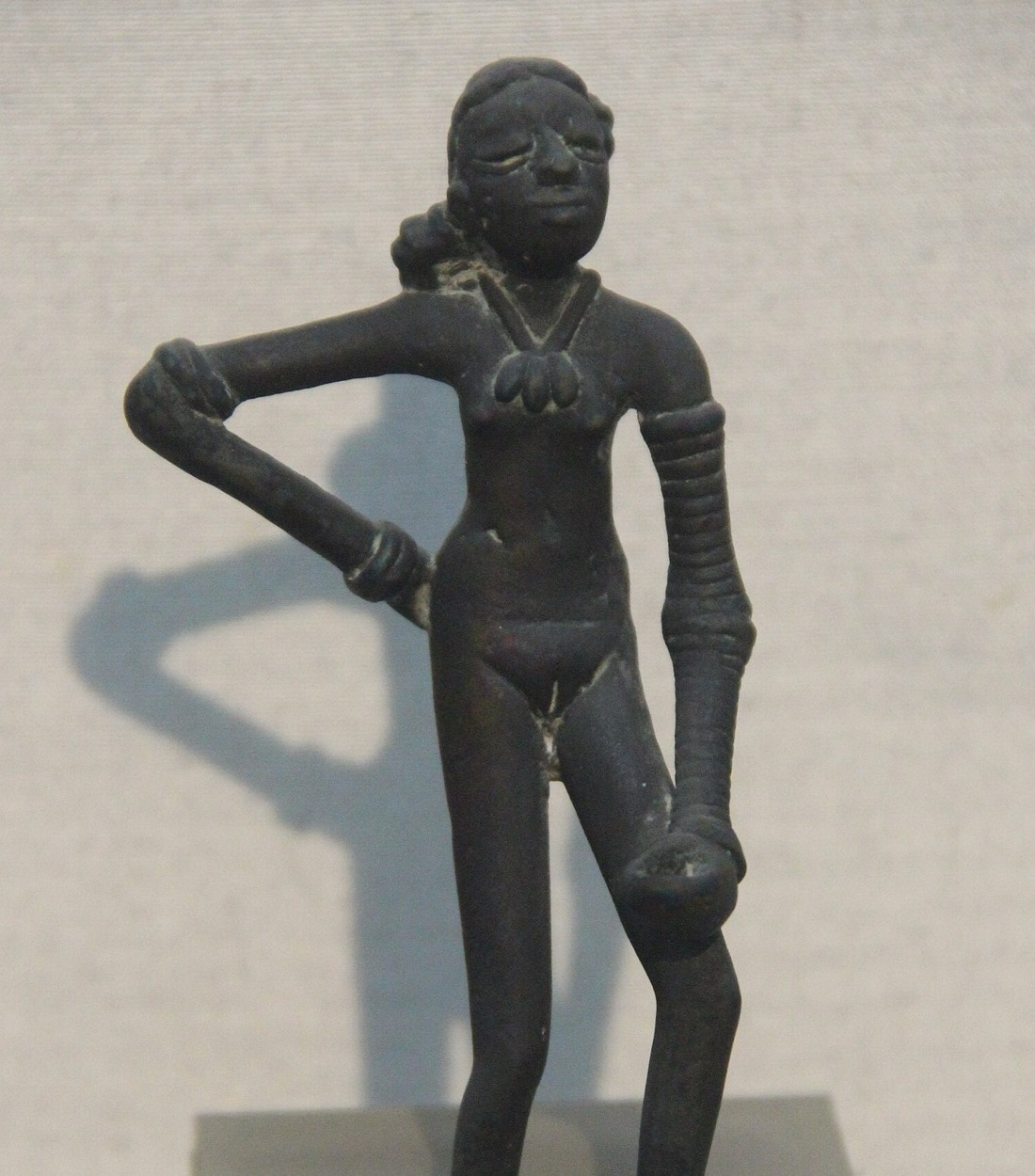
The "Dancing Girl" of Mohenjo-daro. Cast in bronze in an Indus city about 4,500 years ago. She is about as tall as a hand.National Museum, New Delhi. Photo: Gary Todd, via Wikimedia Commons (CC0)
So while ice covered Europe, your mother's line was already at home among the hunters of the Indian forests and shores. It was there when the first fields were planted in the Indus valley. It was there when those villages grew into brick cities with straight streets, wells and covered drains.
Your father's side moved late, and fast. About five thousand years ago, herders with cattle and wagons spread across northern Europe. We find his branch in their graves in Poland, in Czechia and in Germany. Then some of their descendants turned around and went east, across the Volga to the Ural Mountains, where they built walled towns and the first true chariots.
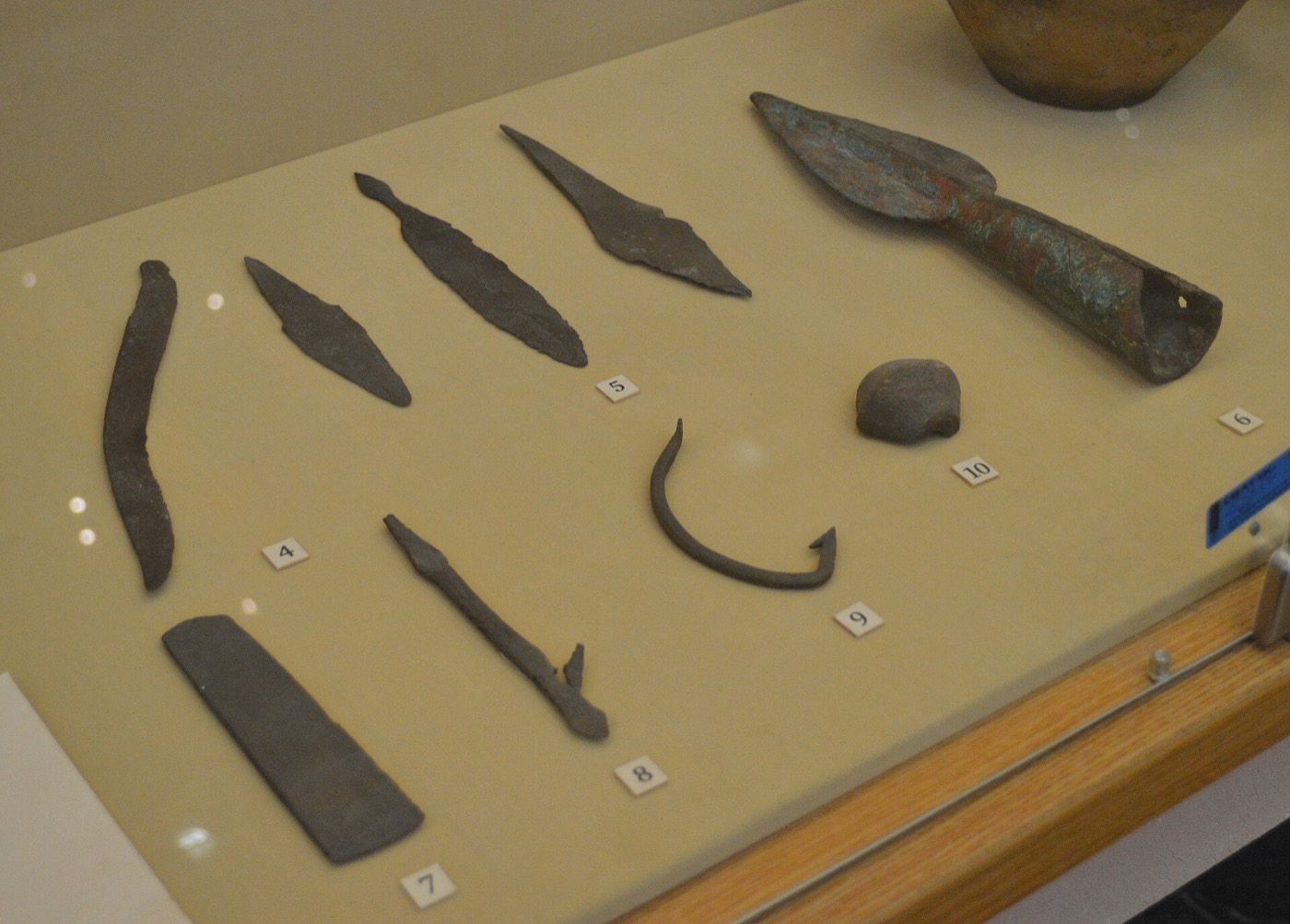
Bronze from the chariot builders. Knives, a spearhead, a sickle and a fish hook of the Sintashta culture, from graves in the southern Urals.Museum of Archaeology and Ethnography, Ufa. Photo: Лапоть, via Wikimedia Commons (CC0)
From there the road runs downhill through history. Across the Kazakh grasslands. South past the oasis towns of Central Asia. Up over the mountain passes. By about 1000 BCE his branch is lying in graves in the Swat valley of northern Pakistan, at the very door of India.
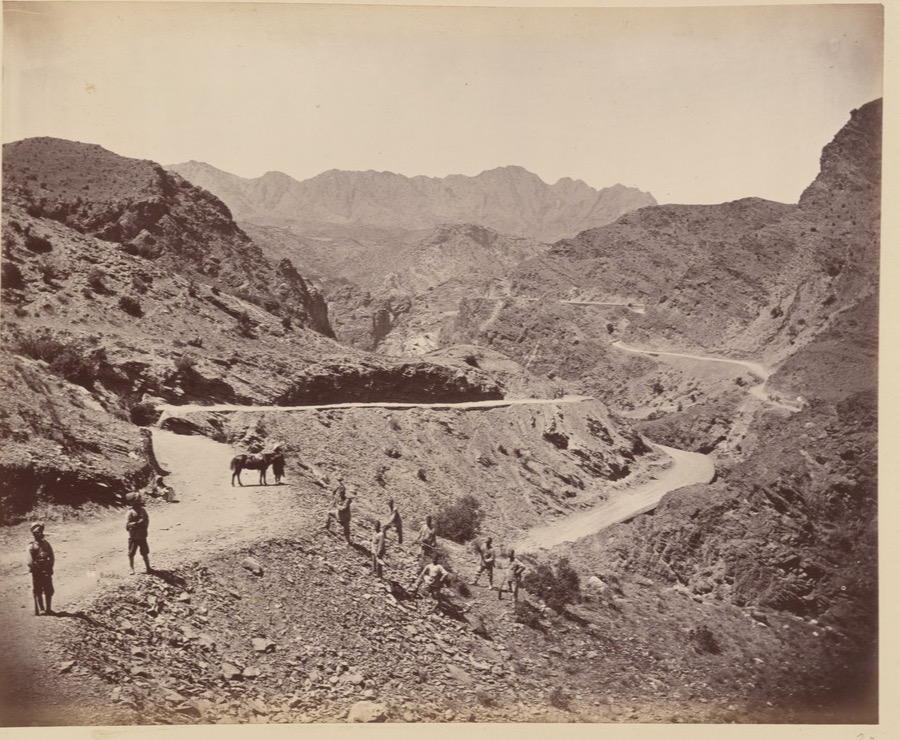
The Khyber Pass, about 1878. The old road between Central Asia and the plains of India, photographed by John Burke. People had been walking it for thousands of years before the camera arrived.John Burke, 1878–1880. Library of Congress, via World Digital Library (public domain)
BBloodline
The peoples who carried it, and the tales they left
Some of these peoples left cities. Some left nothing but graves and songs. Here is who they were.
The first people of India. They hunted with bows tipped with tiny stone blades, traded shell beads from the coast, and painted dancers and deer on the walls of rock shelters. No one has yet read the DNA of a single one of them directly. We know them only because nearly everyone in South Asia still carries a part of them.
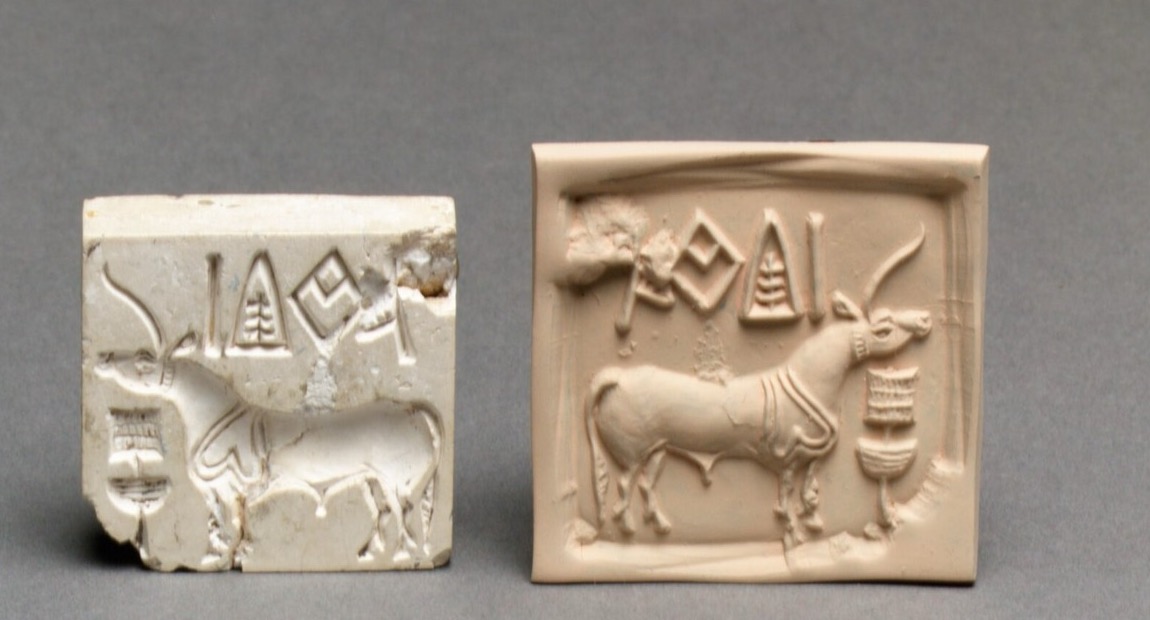
An Indus seal and its impression. A one-horned animal under a line of writing that nobody alive can read. About 2600–1900 BCE.The Metropolitan Museum of Art, Open Access (CC0)
The city builders of the Indus. They wove some of the world's first cotton, weighed their goods with stone cubes cut to a standard, and pressed little carved seals into wet clay. Many seals show a one-horned beast under a line of signs. It is real writing, and after a hundred years of trying, nobody can read a word of it.
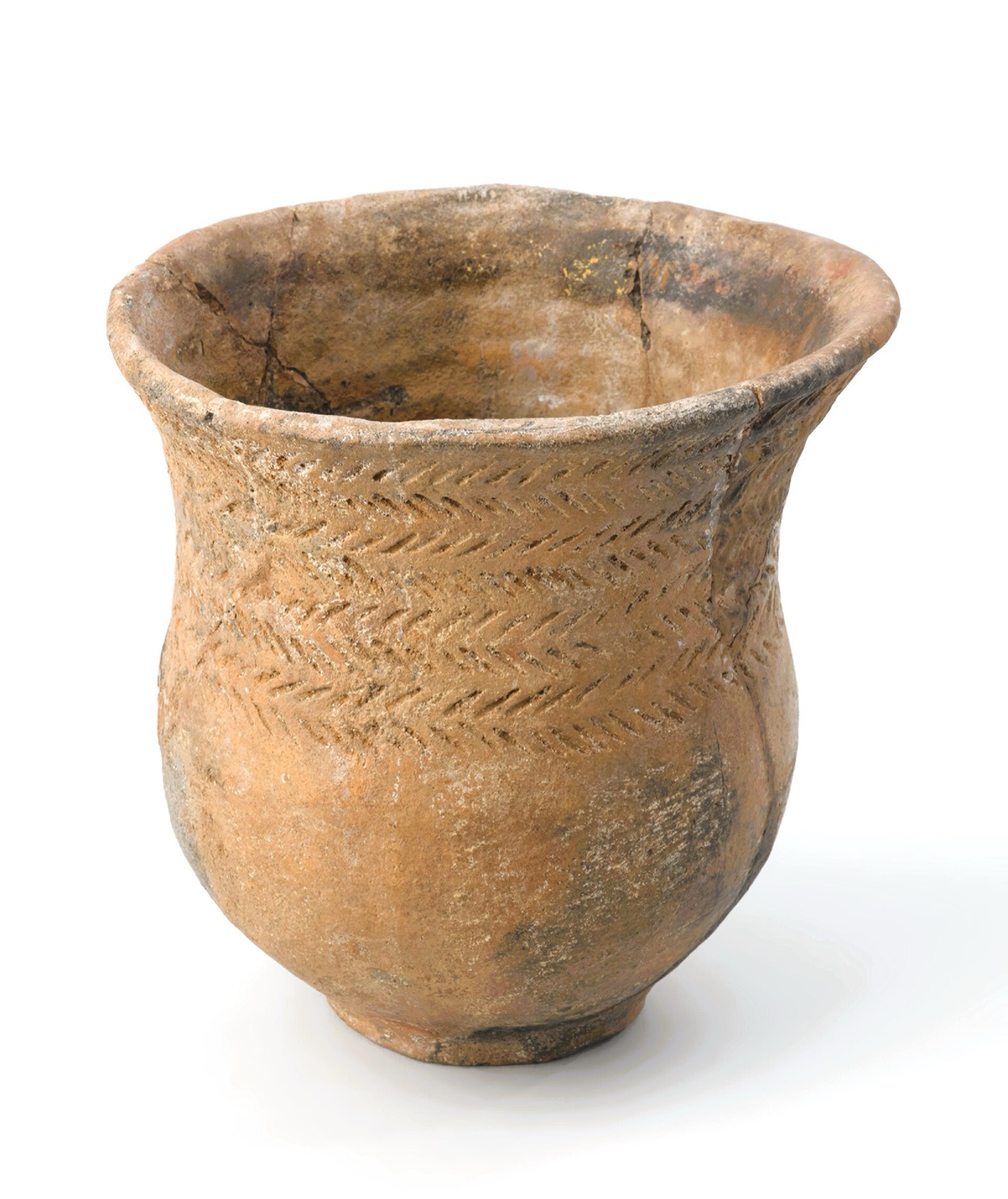
A Corded Ware beaker. Found at Dołuje in Poland. Cups like this were buried with the cattle herders who carried your father's branch.National Museum in Szczecin, via Wikimedia Commons (CC0)
The herders with the battle-axes. In northern Europe your father's branch belonged to the Corded Ware people. Men were buried on their right side with a stone axe, women on their left, all facing south, each with a cup like this one.
The chariot builders. At the edge of the Ural Mountains, the Sintashta people lived in round walled towns where nearly every house had a furnace for copper. When a warrior died, they buried him with his chariot, its spoked wheels set into slots in the grave floor, and a pair of horses laid beside it.
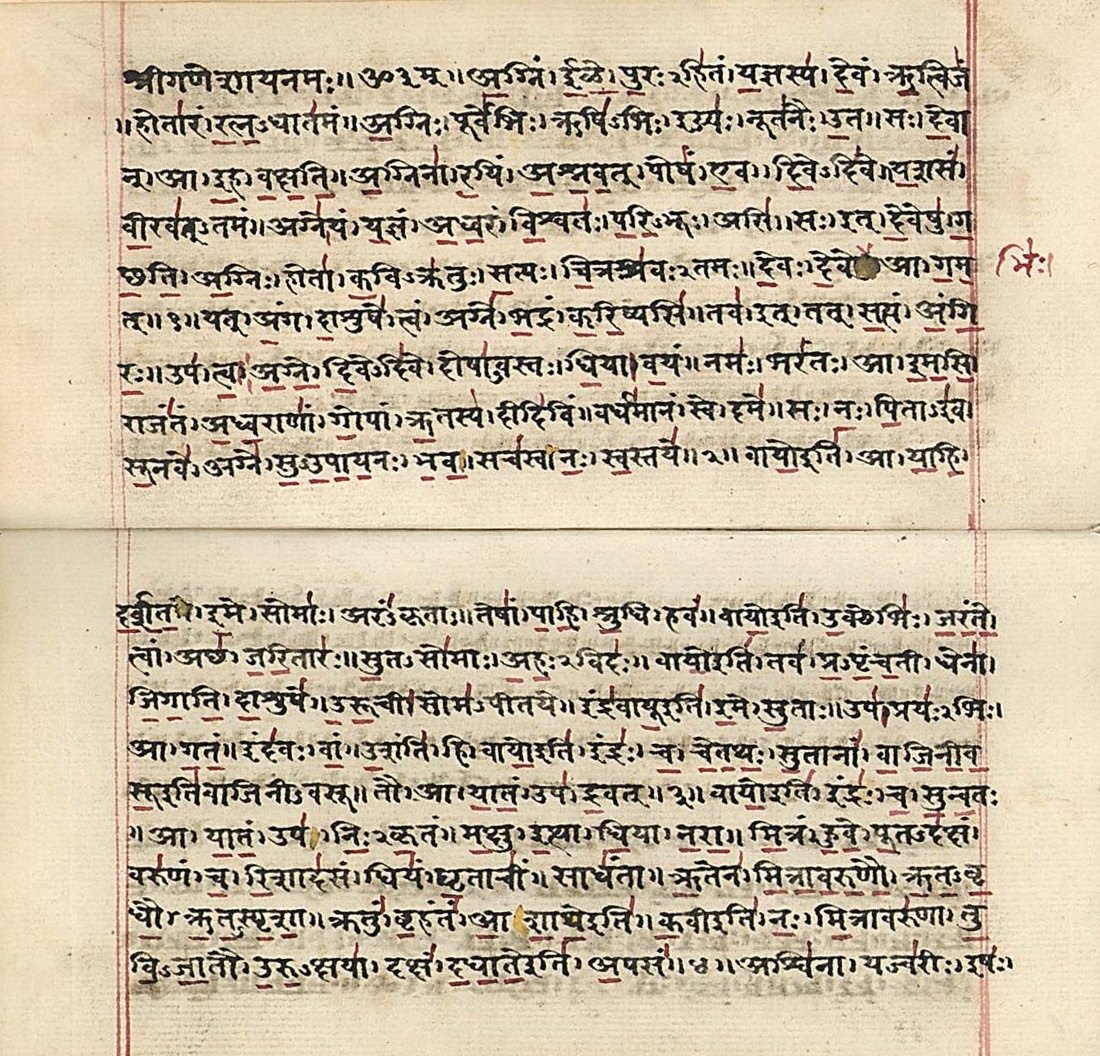
The Rigveda, written down at last. These hymns were passed on by memory for many centuries before anyone wrote them down. This paper copy was made in India in the early 1800s.Schøyen Collection MS 2097, via Wikimedia Commons (public domain)
The riders in gold. A thousand years later, your father's branch rode with the Saka, horse archers of the high Tian Shan. One of their young warriors was buried near Issyk in a suit covered with four thousand gold ornaments shaped like snow leopards and mountain goats.
Legend and song
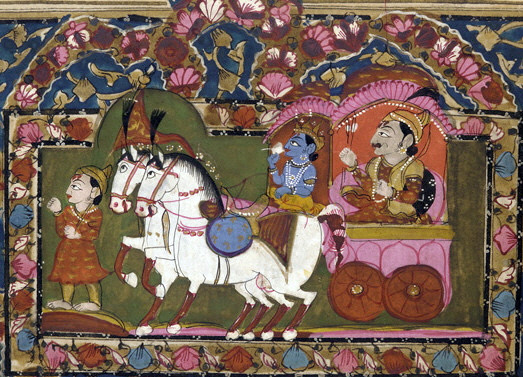
The oldest hymns of India, the Rigveda, are full of horses and chariots. The storm god Indra rides one into battle. The Dawn drives hers across the sky each morning, and the twin Ashvins race theirs to rescue the drowning. In the great epic that came later, the god Krishna himself takes the reins as Arjuna's charioteer and speaks the Bhagavad Gita from the driver's seat. Many scholars think the people who first sang these hymns were distant heirs of the chariot builders of the steppe. It cannot be proved, and it is still argued over.
Krishna drives Arjuna's chariot. A scene from the Mahabharata, painted in India in the 18th or 19th century.Freer and Sackler Galleries, Smithsonian, via Wikimedia Commons (public domain)
The Greeks told their own tale about the riders. They said the nomad queen Tomyris met Cyrus the Great, king of Persia, in battle and beat him. That one is part history and part legend too.
EEndurance
What they lived through
A line lasts this long only by getting through things. Yours got through a great deal.
The cold and the dry. Your mother's people lived through the coldest, driest stretch of the last Ice Age, when the monsoon faltered and the forests shrank. They held on.
The end of the cities. About 1900 BCE the rains weakened and the rivers shifted. The great Indus cities slowly emptied. Their people did not vanish. They moved to smaller villages, east and south, and carried on.
The newcomers. Then the herders came down through the passes with horses and a new language. They did not sweep the old world away. They married into it. Almost everyone in South Asia today descends from both: the people who were already there and the people who arrived.
The open steppe. On your father's side, every generation faced winters that killed herds, rivals on horseback, and thousands of miles of grass with nowhere to hide. His branch crossed all of it.
Legend, and what the bones say
High in the Himalaya there is a small lake called Roopkund, ringed with hundreds of human skeletons. The mountain villages sing of a king who went on pilgrimage with dancers and angered the goddess Nanda Devi, who struck the party down with hailstones as hard as iron. When scientists studied the bones, they found that many of the dead had lived around 800 CE, and that their skulls were cracked by blows from above, round and heavy, like hail. Two of the men at the lake carried your father's branch.
RReturn
And then, you
Every man alive who carries your father's branch descends from one man who lived about 5,300 years ago. Between him and you there are roughly a hundred and seventy fathers. On your mother's side the chain is far longer: many hundreds of mothers, one after another, and for nearly all of that time under the same monsoon sky.
There is a twist in your father's thread that is worth knowing. His branch is the very fork in the road. One side of it went west and became common from Poland to Russia and Scandinavia. The other went east and became common from Central Asia to India. Your file stops exactly at the fork, so we can't yet say which side he stood on. Your DNA as a whole looks most like people from Punjab and Gujarat, with a hint of eastern Europe as well. Either way, the road leads back to the same herders and the same grass.
So you carry both of the great stories of the subcontinent at once: the people who have always been there, and the people who came riding in. When you hear a horse on a hard road, or stand by warm water at dusk, you are closer to them than you think. They are not gone. They got as far as you.
A word about the telling. The places, dates and peoples in this story come from published ancient DNA studies, set out in Part Two. The ancient men named here shared your paternal branch, which means you and they descend from the same distant ancestor. They are relatives on the family tree, not proven direct forebears. No ancient person with your exact maternal branch has been found yet, so that half of the story rests on studies of living people and on archaeology. The legends are later tradition from the same places, and are marked as legend.
Part Two
The Science
What was measured, how each lineage was placed, and which ancient people carried it.
Both lineages on one timeline
Each filled dot is a place where ancient men carrying your paternal branch have been found and dated. Your maternal branch has no ancient carriers yet, so it is drawn as an open dot.
Paternal line, R-M417Maternal line, M6a
Chapter I
Your maternal line: M6a
Your mitochondrial DNA passes from mother to child, almost unchanged, generation after generation. Yours belongs to M6a, a branch of the great lineage M. M is one of the two maternal lineages carried by the first modern humans to settle Asia, and its M6 branch is found today almost only in the Indian subcontinent.
L3›M›M6›M6a
The path from the branch that left Africa (L3) down to your branch, placed using 38 of the mitochondrial markers on this file. All 38 match the branch.
Your branch has not yet turned up in ancient DNA. Neither M6a nor its parent M6 appears among the ancient genomes published so far. That says more about the evidence than about the lineage: DNA survives poorly in hot, wet climates, and only about 200 of the ancient individuals in the reference database come from India, Pakistan and Nepal. As more are sequenced, carriers of M6 will very likely appear, and your report would update.
What the record does show is the wider family. 1,743 ancient people carried branches of M, from a 35,000-year-old hunter at Goyet Cave in Belgium to Ice Age people on the Amur River and the first Americans. Closer to home, sister branches of yours (including M3, M5, M30 and M65) were carried by ancient people buried in Pakistan and northern India, among them Iron Age burials in the Swat valley around 900 BCE.
An Indus seal and its impression. A one-horned animal under a line of writing that nobody alive can read. About 2600–1900 BCE.The Metropolitan Museum of Art, Open Access (CC0)
Where M6 comes from. Studies of living people find M6 concentrated in India, particularly along the Bay of Bengal coast and in Kashmir, and estimate that it arose within South Asia tens of thousands of years ago. Those dates come from counting mutations in present-day people, so they carry wide margins of error.
Ancient Ancestral South Indians
c. 50,000–4,000 years ago
South Asia's first hunter-gatherers, whose deep lineage is woven into almost every population of the subcontinent today.
Indus Valley Civilization
c. 3300–1300 BCE
Builders of grid-planned brick cities with covered drains, whose writing still defies every attempt to read it.
Chapter II
Your paternal line: R-M417
Your Y chromosome passes from father to son, tracing your direct paternal line. Yours belongs to R-M417, the main branch of the lineage often called R1a. According to the YFull tree, this branch split from its relatives about 8,600 years ago, and the men who carry it today share a common paternal ancestor who lived about 5,300 years ago.
R›R1›R1a›R-M459›R-M735›R-M198›R-M417
Placed by comparing the Y-chromosome markers on this file with more than 11,000 ancient and present-day men whose paternal lines are already known. This 2011 file tests too few markers to place you on a finer branch.
In the ancient DNA record, 690 men carried branches of R-M417, most of them buried in Russia, Kazakhstan, Poland, Hungary and Austria. Read in order of date, they trace one of the best-documented migrations in prehistory:
About 2750 BCE · Poland
A Corded Ware burial at Obłaczkowo
Malmström et al. 2019
About 2700–2400 BCE · Czechia and Germany
Corded Ware people at Vliněves, Radovesice and Esperstedt
Papac et al. 2021, Science Advances; Mathieson et al. 2015, Nature
About 1900 BCE · Southern Urals, Russia
At least 18 Sintashta men from the cemetery of Kamennyi Ambar
The culture that built the first spoke-wheeled chariots · Narasimhan et al. 2019, Science
About 1800–1500 BCE · Kazakhstan
Andronovo herders of the Alakul and Fedorovo groups
Narasimhan et al. 2019, Science
About 1000–800 BCE · Swat valley, Pakistan
Iron Age burials at Loebanr and Butkara
Among the earliest steppe paternal lines found in South Asia · Narasimhan et al. 2019, Science
About 700–250 BCE · Kazakhstan and Kyrgyzstan
Saka horse nomads of the steppe and the Tian Shan
Damgaard et al. 2018, Nature; Gnecchi-Ruscone et al. 2021, Science Advances
About 800 CE · Roopkund Lake, India
Two men among the dead at the Himalayan "Skeleton Lake"
Harney et al. 2019, Nature Communications
The Khyber Pass, about 1878. The old road between Central Asia and the plains of India, photographed by John Burke. People had been walking it for thousands of years before the camera arrived.John Burke, 1878–1880. Library of Congress, via World Digital Library (public domain)
These men aren't necessarily your direct ancestors. They share your paternal branch, which means you and they descend from a common man who lived before them. Two much older individuals in the database are also labelled with this branch, but they predate the branch itself and are almost certainly errors in damaged DNA, so we leave them out.
Sintashta chariot builders
c. 2200–1800 BCE
Bronze Age horse people of the Ural steppe who buried the world's oldest known spoke-wheeled chariots with their dead.
Andronovo culture
c. 2000–1150 BCE
Bronze Age herders and miners who spread horses, chariots and bronze across the heart of Asia, from the Urals to the edge of China.
Swat Valley peoples
c. 1400 BCE–1 CE
Valley farmers of the far northwest whose graves hold some of the earliest direct genetic traces of steppe ancestry in South Asia.
Saka (eastern Scythians)
c. 800 BCE–400 CE
Gold-clad riders of the Tian Shan and Altai whose descendants ruled kingdoms from the Silk Road oases to western India.
A fork in the road. Below R-M417 the tree splits in two. One side (R-Z282) is common today in central and eastern Europe; the other (R-Z93) is common in Central and South Asia. The markers on this file place you at the fork but not on either side, so both are possible.
Why two lines are only part of the picture
The number of ancestral slots in your family tree doubles every generation. Your maternal and paternal lines are one slot each.
Parents
5 generations
10 generations
15 generations
20 generations
Chapter III
Who your DNA most resembles today
Comparing the whole file, not just the two lineages, with present-day reference populations (39,032 shared markers), the closest matches are led by South Asians:
Punjabi, Lahore, Pakistan (1000 Genomes)
Gujarati Indian (1000 Genomes)
Telugu, India (1000 Genomes)
Bengali (1000 Genomes)
Russian
Sri Lankan Tamil (1000 Genomes)
A Russian panel appearing among five South Asian ones suggests this person may also have some European ancestry. This comparison ranks whole populations; it can't yet divide a person's ancestry into percentages.
Coming next
Your deep ancestry, in percentages
In validation. The full report will also break your DNA into the ancient populations it descends from, using the same statistical method (qpAdm) as the research papers we cite. We're testing it against real DNA files from every major company first. It will appear in reports only once it meets our accuracy bar.
See what's in your own DNA
Your file stays on your device. Nothing is uploaded.
DNA file: a 23andMe raw data file (2011, genome build 36) released into the public domain by its owner.
Ancient and present-day reference genomes: Allen Ancient DNA Resource v66.p1 (Mallick et al. 2024, Scientific Data; CC0), including the 1000 Genomes Project panels.
Maternal tree: PhyloTree Build 17 (van Oven & Kayser 2009), via the HaploGrep project (MIT license).
Paternal tree and branch ages: YFull YTree v14.06 (CC BY 4.0).
Ancient individuals: as published in the studies cited above.
Images: The Metropolitan Museum of Art Open Access (CC0); Wikimedia Commons (CC0 photographs by Gary Todd and Лапоть; National Museum in Szczecin, CC0); Library of Congress via World Digital Library (John Burke, 1878–1880, public domain); Schøyen Collection manuscript and Smithsonian painting (public domain). Full credits appear under each image.
For education and entertainment only. Sharing a lineage with an ancient person means sharing a distant common ancestor, not direct descent.
 DNAtest