This is what an Origins Story looks like. It was built from a real person's DNA file, read on a computer the way your file would be read on yours. It comes in two parts: the story, told the way you'd tell it around a fire, and then the science behind every line of it.
Whose DNA is this? A volunteer in the Harvard Personal Genome Project (participant hu832966), who chose to share their 23andMe raw data publicly so anyone could learn from it. We show only their participant ID. Their 2012 file contains 955,078 markers. The report speaks to them as "you", the way yours would speak to you.
Pull up a seat. This is the same report told in plain words, in five chapters: Echo, Migration, Bloodline, Endurance, Return.
EEcho
Something very old is still speaking in you
Two threads run through you that are older than any country, any language, any name your family has ever used. One came down from your mother, and her mother, and hers. The other came down from your father, and his father, and his. Almost everything else in your DNA gets shuffled every generation. These two threads don't. They are handed on nearly unchanged, like a song passed down by ear.
We followed both of yours back as far as the bones of ancient people can take us. One leads to a cave above a dry valley in Morocco, where people buried their dead while the Ice Age still gripped the north. The other leads into the green forests of Europe after the ice let go, and on, at last, to a small island off the coast of Ireland.
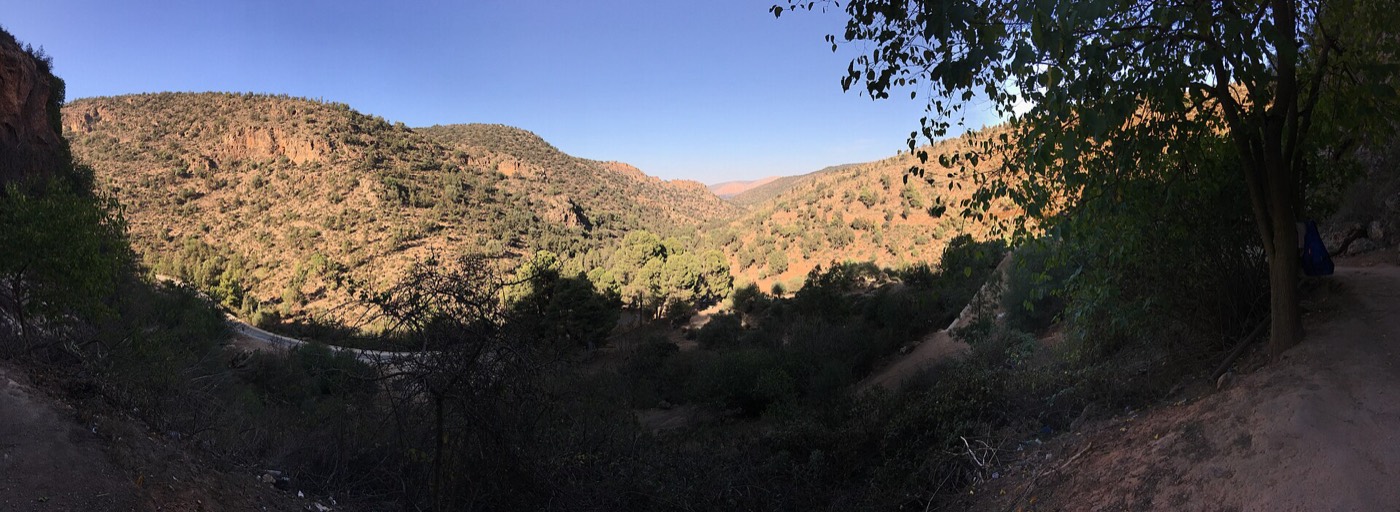
The view from Taforalt cave, Morocco. The hills the Iberomaurusians looked out on. Their dead were buried at the back of this cave about 15,000 years ago.Photo: Velatrix, via Wikimedia Commons (CC0, public domain dedication)
That is where the oldest echo of your father's line was found. So we'll start there.
MMigration
Two roads, walked over fifteen thousand years
Your father's line begins in the warm south. About 14,700 years ago, hunters on the North African coast were snaring wild sheep, roasting acorns and pine nuts, and carrying their dead to the back of the cave at Taforalt. Some of those men carried the branch your father gave you.
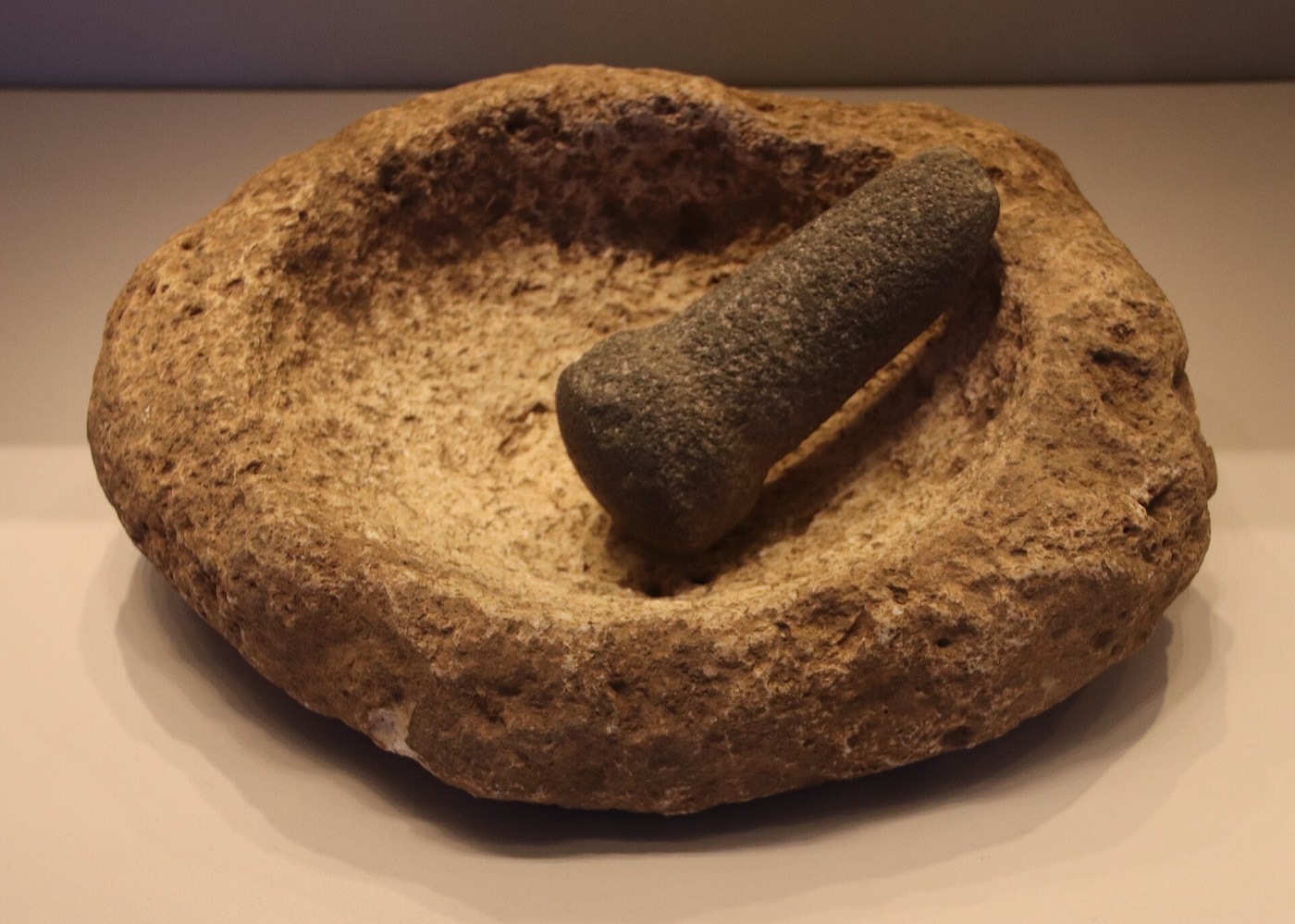
A Natufian mortar and pestle. Stone like this ground wild grain into flour thousands of years before anyone planted a field.Israel Museum, Jerusalem. Photo: Gary Todd, via Wikimedia Commons (CC0)
Two thousand years later the same branch appears far to the east, among the Natufians of the Levant. They did something almost nobody had done before: they stayed put. They built round stone houses, cut wild grain with flint sickles, ground it in stone mortars and baked it into bread, long before the first farm.
From there the line spread wherever people went: around the Mediterranean, down the Nile, up into Europe. At some point it reached the far northwest, and one man handed it to a son, who handed it to a son, until it reached you.
Your mother's line took the northern road. When the ice sheets melted, her people walked into a Europe that was filling up with forest. They hunted deer and boar, fished from dugout canoes, and gathered hazelnuts by the basketful. For thousands of years the whole continent was theirs.
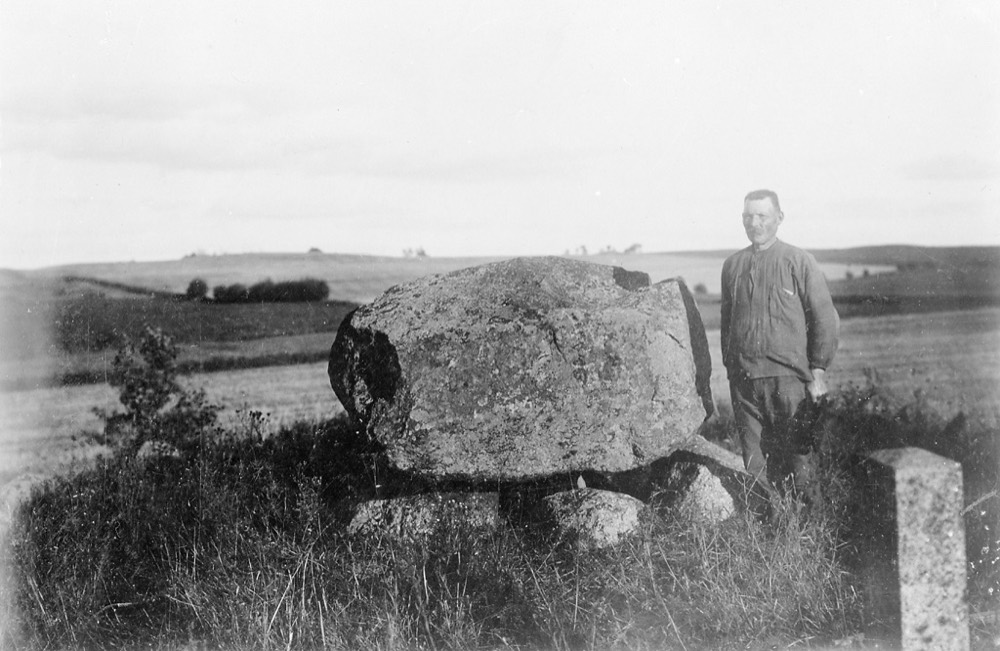
A Stone Age dolmen on Zealand, Denmark, photographed in 1905. Tombs like this were raised by the island's early farmers, the Funnel Beaker people, in the same centuries your maternal branch turns up there.Photo: Lindvall, 6 August 1905. Swedish National Heritage Board, via Wikimedia Commons (no known copyright restrictions)
Then the line turns up in one new world after another. In Denmark, among the first farmers, who raised stone tombs on the island of Zealand. In a cave in Germany, where hunters and farmers lived side by side. On the Baltic island of Gotland, among seal hunters. In Poland, among cattle herders. In the heart of Bronze Age Germany. And at the end of the road, on Rathlin Island, off the north coast of Ireland, about 1900 BCE.
BBloodline
The peoples who carried it, and the tales they left
Nobody wrote anything down in those days. What these peoples left us is what they made, how they buried their dead, and the stories that later grew up around the places they lived.
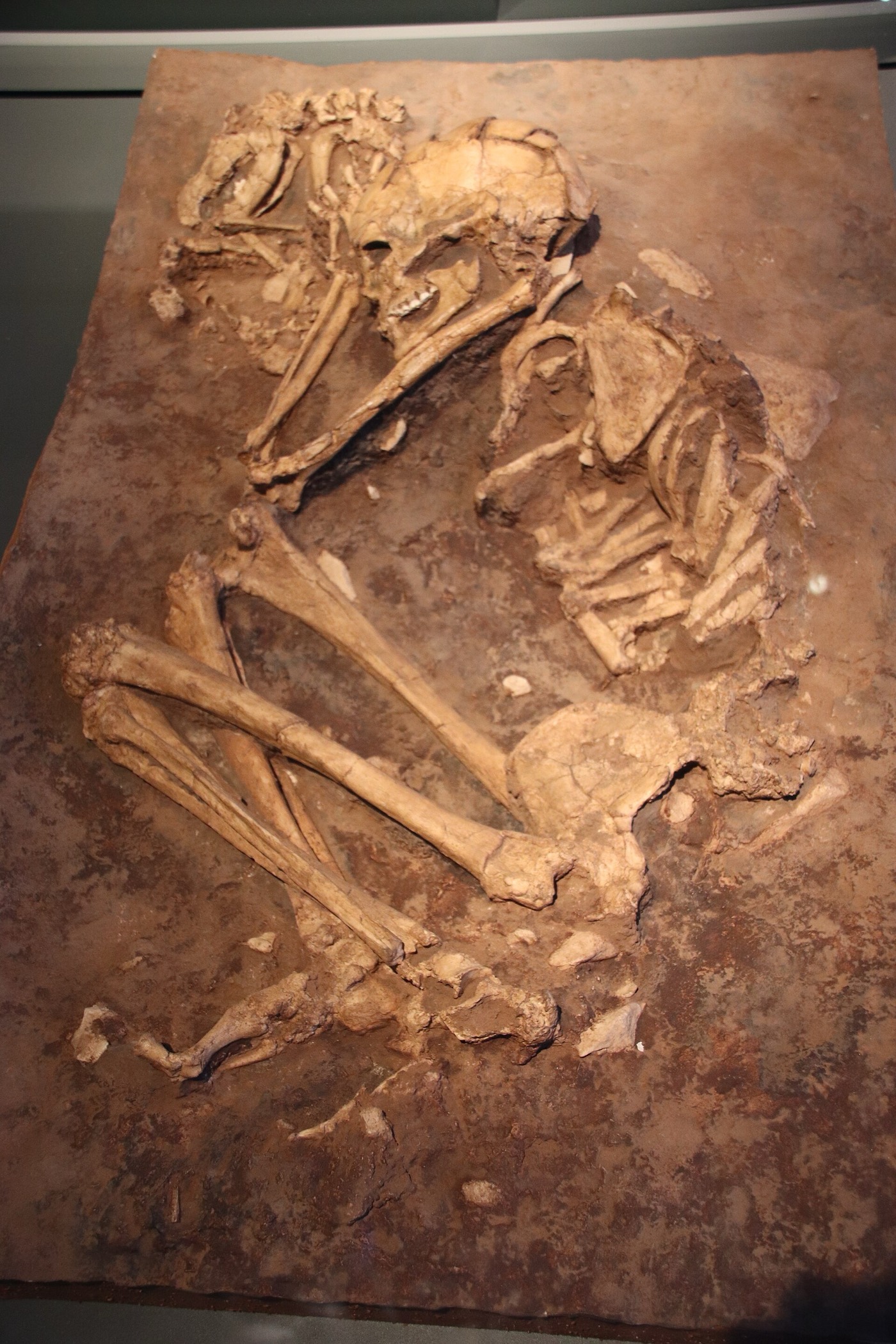
The woman and the puppy. A museum cast of the Natufian burial from Ain Mallaha, where a woman was laid to rest with her hand on a young dog, about 12,000 years ago.Cast, Israel Museum, Jerusalem. Photo: Gary Todd, via Wikimedia Commons (CC0)
The people of the cave. At Taforalt, growing up meant losing your upper front teeth. Nearly every adult had them taken out, most likely as the mark of belonging. You could tell who was one of them the moment they smiled.
The village builders. The Natufians buried their dead beside their homes. One woman was laid to rest with her hand on a puppy. Another, perhaps a healer, went into the ground with fifty tortoise shells and the wing of an eagle. These are some of the oldest signs we have of people loving their dogs and honouring their wise.
The seal hunters. On Gotland, your mother's line was carried by people who refused the plough. Farming had been in Scandinavia for a thousand years, and still they hunted seal from the ice edge and stamped their pots with rows of small pits, as their grandmothers had.
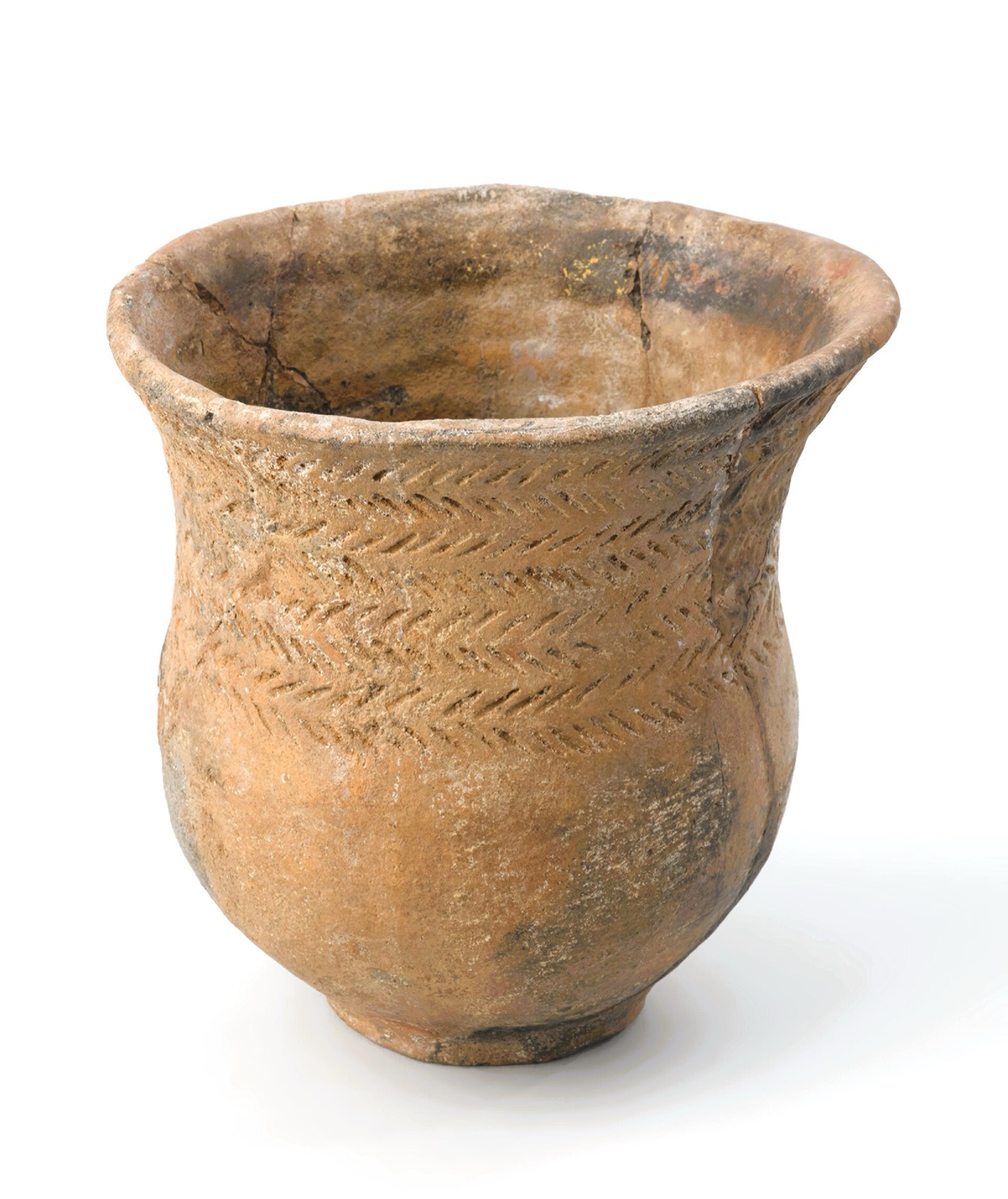
A Corded Ware beaker. Found at Dołuje in Poland. Cups like this went into graves from the Rhine to the Volga.National Museum in Szczecin, via Wikimedia Commons (CC0)
The herders with the battle-axes. The Corded Ware people came out of the east with cattle and wagons, and within a few generations their cups and stone axes lay in graves from the Rhine to the Volga. Men were buried on their right side, women on their left, all of them facing south.
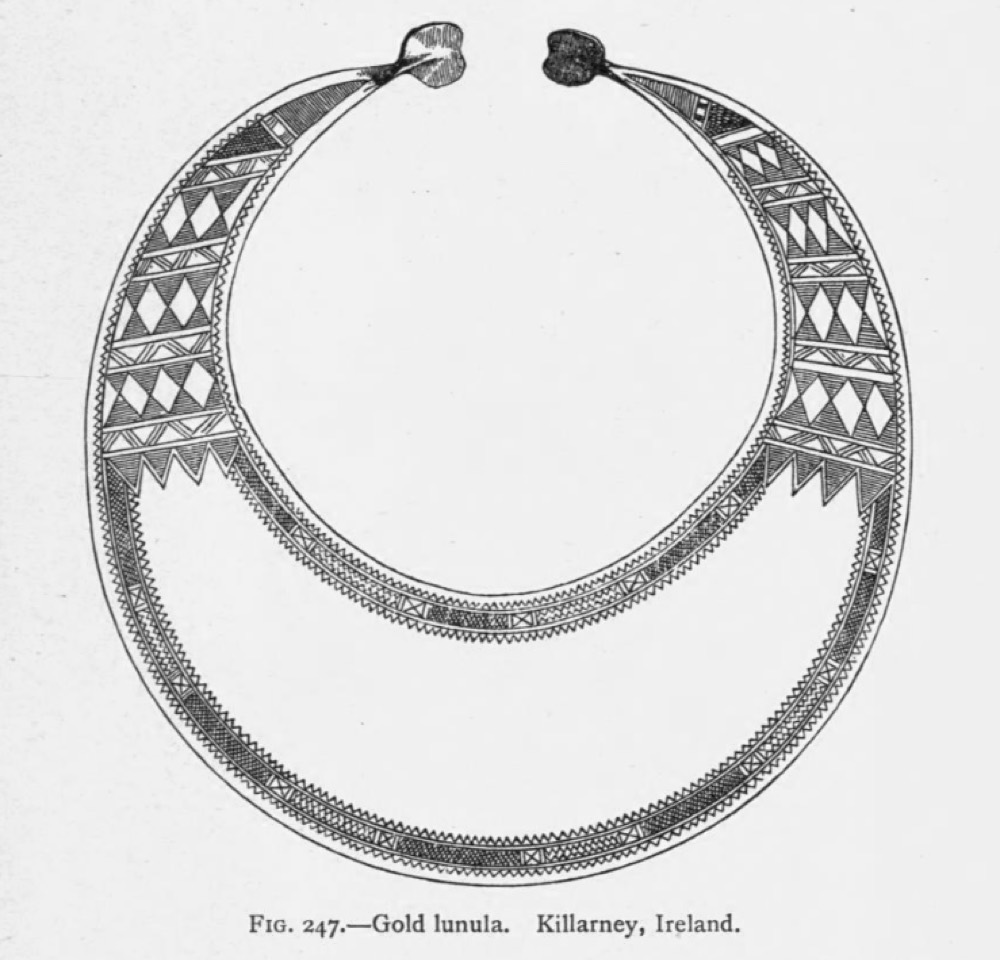
The goldsmiths of the island. By the time your line reached Ireland, miners in Kerry were pulling copper from the rock, and smiths were beating gold into crescent collars thin as a leaf.
Legend, told long afterwards
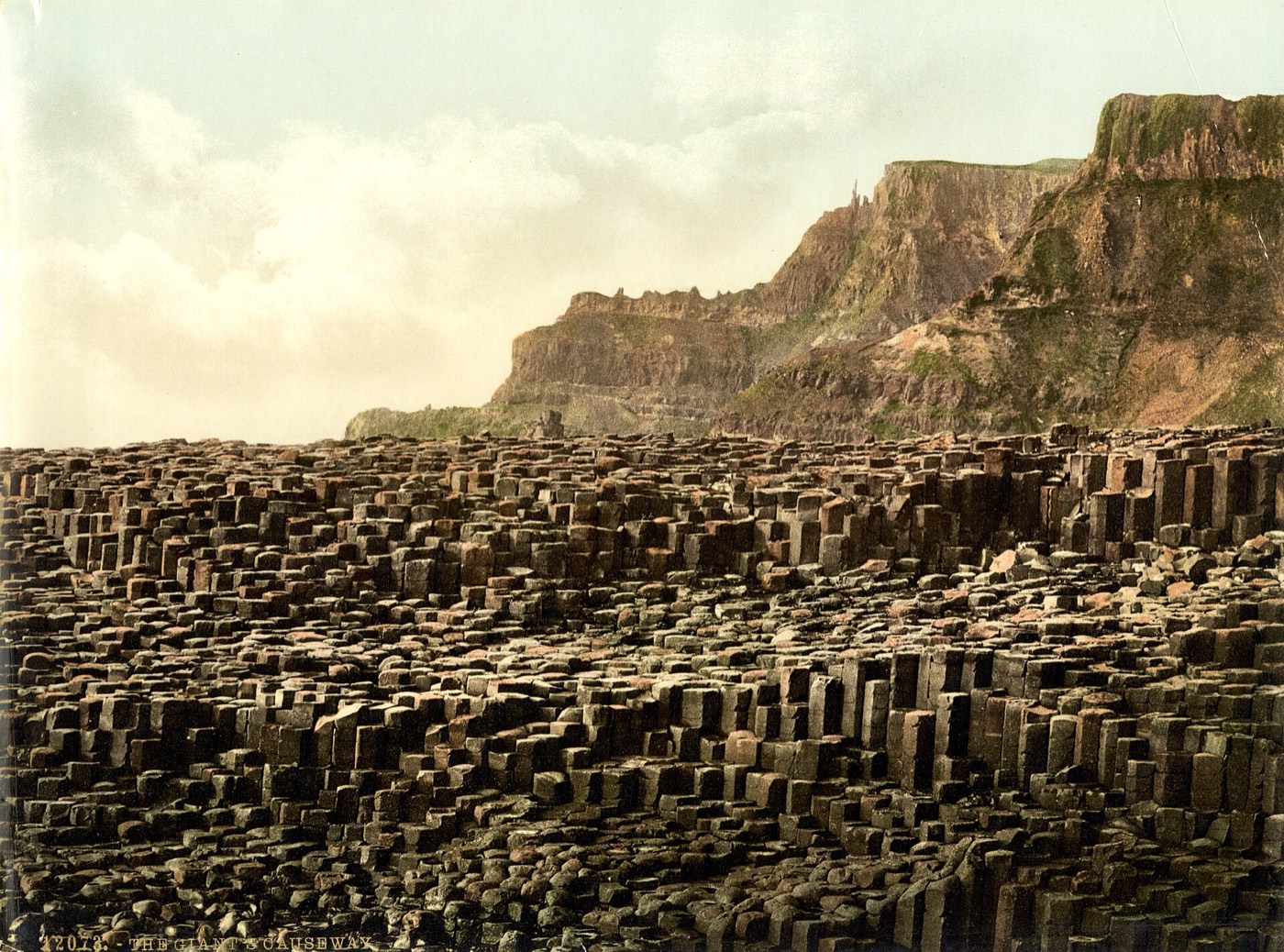
The water around Rathlin Island is the Sea of Moyle. In the old Irish tale, the four Children of Lir were turned into swans by a jealous stepmother and spent three hundred years on that cold sea, singing so sweetly that people came to the shore to listen. And they say the cliffs nearby were built by the giant Finn McCool, who laid a road of stone across the water to fight a rival in Scotland.
Those tales are far younger than the people in your story, and no one can say who first told them. But they belong to the same shore.
EEndurance
What they lived through
The line you carry got here by not breaking. Think about what it had to pass through.
The cold. At the height of the Ice Age, ice a mile thick lay over northern Europe. People held on in the south and waited out winters we can hardly picture. When the warmth finally came, it failed once more, and the world froze again for a thousand years.
The sea. Your mother's people once walked on dry land between Britain and Denmark. The water rose, year by year, until that whole country lay under the North Sea. Around 6200 BCE a great wave from a landslide off Norway swept what was left of it.
The newcomers. Farmers arrived from the south-east with wheat and cattle, and the hunters' way of life slowly ended. Two thousand years later, herders from the eastern grasslands arrived, and the farmers' world was turned over in its turn. Each time, most of the old lines thinned out or vanished.
Yours didn't. A daughter of the hunters married into a farming village. A daughter of the farmers married a herder. Each time the world changed hands, a mother in your line was among the people who stayed, adapted, and raised a girl who lived.
A gold lunula from Killarney, Ireland. Crescent collars of beaten gold were made in Ireland in the first centuries of metalworking, around the time of the Rathlin Island burials.Engraving from E. A. Parkyn, An Introduction to the Study of Prehistoric Art, 1915 (public domain)
The same is true on your father's side. His branch is about 34,000 years old. It has outlasted the Ice Age, the drying of the Sahara, and every empire the Mediterranean ever raised and lost.
RReturn
And then, you
Between the man buried on Rathlin Island and you, there are roughly a hundred and fifty generations. A hundred and fifty mothers, each of whom lived long enough to have a daughter. Not one of them knew she was carrying something this old.
The Antrim coast in the 1890s. The Giant's Causeway, a few miles along the shore from Rathlin Island, in a hand-coloured photochrom print.Detroit Publishing Co., between 1890 and 1900. Library of Congress, Prints and Photographs Division (public domain)
Today your DNA as a whole looks like that of people from Britain and north-western Europe. That is the big picture, made from all your ancestors together. The two threads in this story are only two of them. But they are the two we can follow by name, hand to hand, without a single break, all the way back to the fire in the cave.
So when you take up a cup, or call a dog to your side, or stand at the edge of the sea and look out, you are doing something the people in this story did too. They are not gone. They got as far as you.
A word about the telling. The places, dates and peoples in this story come from published ancient DNA studies, set out in Part Two. The ancient people named here shared your maternal or paternal branch, which means you and they descend from the same distant ancestor. They are relatives on the family tree, not proven direct forebears. The legends are later folklore from the same places, and are marked as legend.
Part Two
The Science
What was measured, how each lineage was placed, and which ancient people carried it.
Both lineages on one timeline
Every dot is a place where ancient people carrying one of your branches have been found and dated.
Paternal line, E-M35Maternal line, U5b
Chapter I
Your maternal line: U5b2a2b1
Your mitochondrial DNA passes from mother to child, almost unchanged, generation after generation. It traces one thread back through your mother, her mother, and so on into deep time. Yours belongs to U5, one of the oldest maternal lineages in Europe and the signature lineage of the continent's Ice Age and Mesolithic hunter-gatherers.
The path from the branch that left Africa (L3) down to your exact branch, placed using 47 of the mitochondrial markers on this file. 46 match the branch exactly.
In the ancient DNA record, 190 people who lived more than 6,000 years ago carried branches of U5b, most of them hunter-gatherers buried in France, Ukraine, Italy, Serbia and Denmark. Your more specific branch, U5b2a2, appears in people across northern and central Europe as farming and then metal-working spread:
About 4100 BCE · Denmark
An early farmer at Ravnsbjerggård, Zealand
Funnel Beaker culture · Allentoft et al. 2024, Nature
About 3600 BCE · Germany
A person buried in the Blätterhöhle cave
Where hunter-gatherers and farmers lived side by side for centuries · Lipson et al. 2017, Nature
About 3000–2800 BCE · Gotland, Sweden
Four Pitted Ware hunter-fishers at Ajvide and Västerbjers
Seal hunters of the Baltic who kept a foraging life long after farming arrived · Coutinho et al. 2020
About 2400 BCE · Poland
A Corded Ware burial at Pikutkowo
Fernandes et al. 2018, Scientific Reports
About 2100–1900 BCE · Czechia and Germany
Bronze Age Únětice people, including at Leubingen, Thuringia
Papac et al. 2021, Science Advances; Penske et al. 2024, Scientific Reports
About 1900 BCE · Rathlin Island, Ireland
A Bronze Age man, one of the first ancient Irish genomes ever sequenced
Cassidy et al. 2016, PNAS
Zealand, Denmark. A dolmen of the island's early farmers, photographed in 1905. The oldest U5b2a2 carrier on this timeline was buried on the same island.Photo: Lindvall, 1905. Swedish National Heritage Board, via Wikimedia Commons (no known copyright restrictions)
That pattern is typical of U5 lines: they began with Europe's hunter-gatherers and were carried on by their descendants after they mixed with incoming farmers and, later, steppe herders. These people aren't necessarily your direct ancestors. They share your maternal branch, which means you and they descend from a common woman who lived long before them.
Western Hunter-Gatherers
c. 12,000–4000 BCE
Often blue-eyed hunters, fishers and canoe-builders who had Europe's forests and coasts to themselves after the last Ice Age.
Copper miners and goldsmiths of Ireland whose genomes from a small northern island shed new light on the island's deep past.
Chapter II
Your paternal line: E-M35
Your Y chromosome passes from father to son, tracing your direct paternal line. Yours belongs to E-M35 (also written E1b1b1). According to the YFull tree, this branch split from its relatives about 34,600 years ago, and the men who carry it today share a common paternal ancestor who lived about 23,900 years ago.
E›E-M5479›E-P147›E-P177›E-M5557›E-M215›E-M35
Placed by comparing 456 Y-chromosome markers on this file with more than 11,000 ancient and present-day men whose paternal lines are already known.
E-M35 is common today around the Mediterranean, in North and East Africa and in the Near East, and is found at lower frequency across Europe, including Britain. Its earliest carriers in the ancient DNA record are some of the most famous ancient people of all:
About 12,700 BCE · Morocco
Iberomaurusian hunter-gatherers of Taforalt cave
Among the oldest human genomes ever recovered from Africa · van de Loosdrecht et al. 2018, Science
About 10,750 BCE · Israel
Natufians, among the first people anywhere to live in villages
Lazaridis et al. 2016, Nature
Later
306 men in the ancient record carry branches of E-M35
Buried in Austria, Hungary, Israel, Italy, Serbia, Sudan, Kenya, Spain and beyond
The view from Taforalt cave, Morocco. The hills the Iberomaurusians looked out on. Their dead were buried at the back of this cave about 15,000 years ago.Photo: Velatrix, via Wikimedia Commons (CC0, public domain dedication)
Iberomaurusians
c. 23,000–9000 BCE
Ice Age foragers of North Africa's coast, whose cave cemeteries hold some of the oldest human genomes from Africa.
Natufians
c. 13,000–9500 BCE
Among the first people on Earth to settle in villages, bake bread and bury their dead with their dogs, all before farming began.
Why two lines are only part of the picture
The number of ancestral slots in your family tree doubles every generation. Your maternal and paternal lines are one slot each.
Parents
5 generations
10 generations
15 generations
20 generations
One line among thousands. Your Y chromosome is a single ancestral line. Go back 20 generations and you have about a million ancestral slots, and your paternal line is just one of them. That's why this person's paternal line can point to North Africa and the Near East while their DNA as a whole is northwestern European.
Chapter III
Who your DNA most resembles today
Comparing the whole file, not just the two lineages, with present-day reference populations, the closest matches are all European, led by northwestern Europeans:
Utah residents with northern and western European ancestry (1000 Genomes CEPH panel)
British, England and Scotland (1000 Genomes)
Spanish (1000 Genomes)
Tuscan, Italy (1000 Genomes)
Russian
Orcadian, Orkney Islands
For comparison, 23andMe's own Ancestry Composition for this person (exported in 2019) was mostly European, led by British & Irish and broadly northwestern European, with a few percent Sub-Saharan African.
Coming next
Your deep ancestry, in percentages
In validation. The full report will also break your DNA into the ancient populations it descends from, such as Europe's hunter-gatherers, first farmers and steppe herders, using the same statistical method (qpAdm) as the research papers we cite. We're testing it against real DNA files from every major company first. It will appear in reports only once it meets our accuracy bar.
See what's in your own DNA
Your file stays on your device. Nothing is uploaded.
DNA file: Harvard Personal Genome Project participant hu832966, 23andMe v3 (2012), released under CC0.
Ancient and present-day reference genomes: Allen Ancient DNA Resource v66.p1 (Mallick et al. 2024, Scientific Data; CC0), including the 1000 Genomes Project panels.
Maternal tree: PhyloTree Build 17 (van Oven & Kayser 2009), via the HaploGrep project (MIT license).
Paternal tree and branch ages: YFull YTree v14.06 (CC BY 4.0).
Ancient individuals: as published in the studies cited above.
Images: Wikimedia Commons (CC0 photographs by Velatrix and Gary Todd; National Museum in Szczecin, CC0), Swedish National Heritage Board (1905, no known copyright restrictions), Library of Congress Prints and Photographs Division (photochrom, 1890s, public domain), and E. A. Parkyn, An Introduction to the Study of Prehistoric Art (1915, public domain). Full credits appear under each image.
For education and entertainment only. Sharing a lineage with an ancient person means sharing a distant common ancestor, not direct descent.
 DNAtest