 DNAtest
Roman DNA: What Ancient Genomes Reveal About the People of Rome
DNAtest360 earns a commission if you buy through links on this page.
Picture a crowd in the Forum around 150 CE: senators in togas, sailors off the grain ships, merchants from Alexandria and Antioch, soldiers on leave, enslaved household workers, freed families who had made good. Who were these people, and where did their families come from? Roman writers told us about emperors and battles, but little about the ancestry of ordinary Romans. Their bones have now spoken. Ancient DNA from the city of Rome, from Pompeii and from across the empire shows that Imperial Rome was one of the great genetic crossroads of the ancient world, and that its people looked, in their ancestry, much more like the eastern Mediterranean than most of us would have guessed.
In short
- A 2019 study of 127 genomes from 29 sites in and around Rome, spanning 12,000 years, found that by Rome's founding the region's people already resembled today's Mediterranean populations.
- During the Imperial period, Rome received large-scale immigration from the eastern Mediterranean and Near East. Most people sampled from the imperial city carried ancestry shifted toward that region.
- In Etruria, central Italy, the shift was abrupt: about 50% eastern Mediterranean admixture population-wide. Pompeii's victims showed the same pattern.
- There is no single "Roman DNA". Roman citizens came from everywhere, and a test can show Mediterranean-related ancestry, not descent from Romans as such.
Who were the Romans?
Rome began, by tradition in 753 BCE, as a town of Latin-speaking farmers on the hills above the Tiber, a neighbour of the far richer Etruscan cities to the north. It grew into a republic that conquered first Italy and then the Mediterranean. After a century of civil wars, Augustus became the first emperor in 27 BCE, and the two centuries of relative peace that followed, the Pax Romana, held together an empire of roughly 70 million people, from Britain and Portugal to Egypt and Syria.
"Roman" was never an ethnic label for long. It was a legal and political one. Citizenship spread from the city to its Italian allies, then to provincial towns and veteran soldiers, and in 212 CE the emperor Caracalla gave it to nearly all free people in the empire. An emperor could come from a family in Spain, like Trajan and Hadrian, from North Africa, like Septimius Severus, or from Arabia, like Philip the Arab. That is the first thing to keep in mind when anyone asks whether they have Roman DNA.
A city of perhaps a million
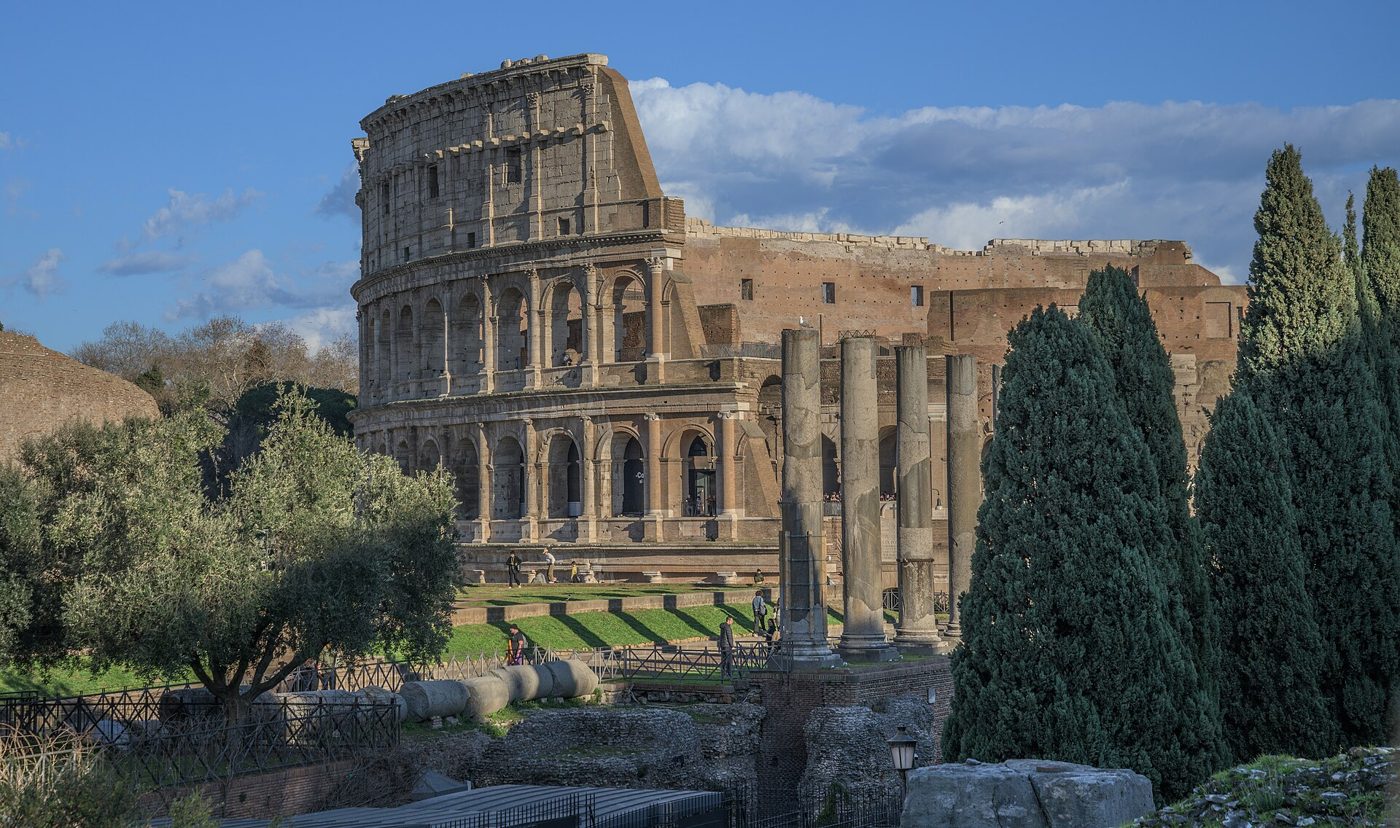
At its height, the city of Rome may have held around a million people, one of the largest cities anywhere before the modern age. Feeding it took grain fleets from Egypt and North Africa, wine and olive oil shipped in clay amphorae from Spain and Gaul, and a constant flow of people. Some came freely as traders, craftsmen, teachers and doctors, many of them Greek-speaking. Many others came in chains. Enslaved people were bought and sold across the Mediterranean, and in Rome a great many were later freed, becoming citizens whose children were born Roman.
Cities in the ancient world were also deadly places, with crowding and disease that killed more people than were born. A great city could only stay great by drawing in new people all the time. Historians had long suspected this made Rome a melting pot. Ancient DNA has now measured it.
What 12,000 years of Roman genomes revealed
In 2019, Margaret Antonio, Ziyue Gao, Hannah Moots and colleagues, led by Jonathan Pritchard, Ron Pinhasi and Alfredo Coppa, published genomes from 127 people buried at 29 sites in and around Rome, from hunter-gatherers of about 10,000 BCE to the early modern period. They found six chapters in the story:
- Hunter-gatherers. The earliest people resembled the Western Hunter-Gatherers found across Europe.
- The first farmers. Farming brought a near-complete change of ancestry, to people descended from Anatolian farmers, as it did across Europe.
- Before the Iron Age, a second transition added new ancestry, including the steppe ancestry that spread with Indo-European languages, and ancestry related to Iran and the Caucasus.
- At Rome's founding, the region's people already looked genetically much like present-day Mediterranean Europeans, though individuals already varied.
- The Imperial period brought net immigration from the Near East and eastern Mediterranean. Most of the imperial-era people sampled in Rome clustered with eastern Mediterranean and Near Eastern populations, and very few resembled western Europeans.
- Late antiquity and the Middle Ages brought a swing back toward Europe, as the empire divided, Rome shrank and newcomers such as the Goths and Lombards arrived in Italy.
The authors noted that these ancestry shifts tracked Rome's political world. When the empire's centre of gravity lay in the east, its most populous, urban and wealthy provinces, people flowed from there to the capital. When the city's ties turned north and west, its ancestry followed. Throughout, individuals differed widely, with gene flow from across the Mediterranean, Europe and North Africa.
Etruria, Pompeii and the frontiers
Rome itself might have been unusual, the way a modern capital is. So other studies looked beyond it.
- Etruria. Cosimo Posth and colleagues sequenced 82 people from Etruria and southern Italy, from 800 BCE to 1000 CE. Through the first millennium BCE, the local gene pool stayed largely stable, even though individuals of central European, North African and Near Eastern ancestry turn up. Then, in the Roman Imperial period, came an abrupt, population-wide shift to about 50% eastern Mediterranean ancestry. In the early Middle Ages, northern European ancestry arrived, completing the mix that shaped people in central Italy today.
- Pompeii. In 2024, a team studying DNA from skeletons inside the famous plaster casts of Vesuvius's victims found that their sexes and family ties often didn't match the stories told about them. An adult wearing a gold bracelet with a child on their lap, long called a mother and child, was an adult male unrelated to the child. And all the Pompeiians with genome-wide data drew their ancestry largely from recent immigrants from the eastern Mediterranean, matching the pattern in Rome.
- The Balkan frontier. A 2023 study of 136 people from the 1st millennium CE along the Middle Danube found little ancestry from people of Italic descent, despite the legions and Roman culture everywhere. Instead it found a large influx of people with Anatolian ancestry during the Imperial period, then Central and Northern European and steppe migrants from about 250 CE, and finally the arrival of Slavic-speaking people who contributed 30% to 60% of later Balkan ancestry.
- Roman Britain. At a Roman-era cemetery in York, six of seven people analysed in a 2016 study were genetically close to the earlier Iron Age Britons, but one man carried ancestry pointing to the Middle East. Even at the empire's northern edge, people came from far away.
The picture that emerges is consistent. The empire moved people on a scale not seen again in Europe for over a thousand years, and much of that movement ran from the populous east toward Italy. But "Romanization" in the provinces was mostly cultural. Local people became Roman by law, language and lifestyle, not by being replaced by settlers from Italy.
A few cautions about the evidence
These studies are powerful, but they have limits worth knowing.
- Small samples. A few dozen imperial-era people stand in for a city of perhaps a million. Who was buried where, and whose bones survive, shapes the result.
- "Eastern Mediterranean" is a broad label. It covers Greece, the Aegean, Anatolia and the Levant, regions that were genetically similar. DNA can't tell a family from Ephesus from one from Antioch, and it can't tell us whether a person was enslaved, freed or free.
- Ancestry is not identity. A person with eastern ancestry buried in Rome was as Roman as anyone, by law and often by birth. Ancient DNA tells us where families came from, not what they called themselves.
Do you carry Roman DNA?
If your family comes from Italy, almost certainly some of your ancestors lived in the Roman world, and part of the eastern Mediterranean signal of the imperial period likely survives in you, layered on the older Iron Age base of Italy and on later medieval inputs from central and northern Europe. People from Greece, the Balkans, Spain, France and elsewhere around the Mediterranean also descend in large part from the empire's inhabitants, though in those regions the empire changed language and culture far more than ancestry.
What no test can do is find "Roman DNA" as such, because the Romans were not one people. Here is what a test can show:
- Ethnicity estimates. AncestryDNA, 23andMe and MyHeritage report regions such as "Italy", "Southern Italy" or "Greece and Albania". These describe resemblance to people living there today, which in turn reflects the ancient mixing described above. They don't separate Etruscans from Latins or a Roman from a Greek.
- Paternal and maternal lines. Your haplogroups trace single lines back thousands of years. Paternal lines common in Italy today include R1b, J2, E1b and G2. Each was in the Mediterranean long before Rome, so a line can show deep Mediterranean roots but not that your ancestor was a Roman. See what your haplogroup means.
- Ancient genome matches. The most direct comparison is your DNA against the actual people buried in Rome, Etruria and the provinces. A close match shows how much you resemble them, not that any of them is your ancestor.
Already have a raw DNA file from 23andMe, AncestryDNA, MyHeritage or FamilyTreeDNA? (Here's how to download it.) Our free analyzer compares it with thousands of ancient genomes, including people from Iron Age and Imperial Italy, and shows which ancient peoples carried your maternal and paternal lines.
Already have a 23andMe, AncestryDNA or MyHeritage file? Open it in our free analyzer. It runs entirely in your browser, and your DNA is never uploaded.
Try the free analyzerIt runs in your browser, so your DNA file is never uploaded. Haven't tested yet? For family history and finding relatives, AncestryDNA has the largest database. To pin your paternal line to a precise branch, FamilyTreeDNA's Y-DNA tests go deepest. Not sure which fits? Take our 30-second quiz.
Frequently asked questions
What did ancient Romans look like genetically?
It depends on when. Around Rome's founding, people in central Italy resembled today's Mediterranean Europeans. During the Imperial period, most people sampled in Rome and Pompeii carried ancestry shifted toward the eastern Mediterranean and Near East, while individuals varied widely, with some of European or North African ancestry.
Are Italians descended from the Romans?
Largely, yes, in the sense that most Italians descend from the people who lived in Roman Italy. But those people were themselves a mix of Iron Age Italians and imperial-era immigrants, and medieval arrivals from central and northern Europe added further ancestry. Present-day Italians carry all of these layers.
Were the Etruscans the same as the Romans?
No. The Etruscans spoke a non-Indo-European language and had their own cities, but genetically they were very similar to their Latin-speaking neighbours, including steppe ancestry. Rome absorbed them, and their language faded after about 90 BCE.
Did Roman soldiers leave their DNA across Europe?
Less than you might think. Studies in the Balkans found little ancestry from Italy despite heavy Roman military presence, and Roman-era people in York were mostly local Britons. Soldiers were often recruited in the provinces, and many settled where they served. The empire spread language and culture more than Italian ancestry.
Sources
- Antonio et al. 2019, "Ancient Rome: A genetic crossroads of Europe and the Mediterranean," Science
- Posth et al. 2021, "The origin and legacy of the Etruscans through a 2000-year archeogenomic time transect," Science Advances
- Pilli et al. 2024, "Ancient DNA challenges prevailing interpretations of the Pompeii plaster casts," Current Biology
- Olalde et al. 2023, "A genetic history of the Balkans from Roman frontier to Slavic migrations," Cell
- Martiniano et al. 2016, "Genomic signals of migration and continuity in Britain before the Anglo-Saxons," Nature Communications
- Wikipedia, "Roman Empire"