 DNAtest
Who Were the Western Hunter-Gatherers? Europe's First People
DNAtest360 earns a commission if you buy through links on this page.
For thousands of years after the last Ice Age, Europe's forests, rivers and coasts belonged to bands of hunters, fishers and canoe-builders. Geneticists call them the Western Hunter-Gatherers. Their genomes overturned old ideas about what early Europeans looked like, and a share of their DNA survives in nearly every person of European descent today.
In short
- The Western Hunter-Gatherers spread across western and central Europe from at least 14,000 years ago and lived there until farming arrived, from about 6000 BCE.
- Their genomes, from people such as Cheddar Man in England and the La Braña man in Spain, show many had blue or green eyes and probably dark skin.
- Their men mostly carried paternal haplogroup I (especially I2), and their maternal lines were mostly U5 and U4.
- Every European population carries some of their ancestry. It's highest around the eastern Baltic. Consumer ethnicity estimates don't report it, but your haplogroups can carry their signal.
Who were the Western Hunter-Gatherers?
Modern humans reached Europe more than 45,000 years ago, but Europe's early history was one of repeated turnover. A 2016 study of 51 ancient Eurasians found that the very first modern humans in Europe left no detectable trace in people living there today. Then, during the warming that began about 14,000 years ago, a new genetic profile spread widely across the continent, one with links to people of the Near East. Researchers first called it the Villabruna cluster, after a hunter buried in the Italian Alps.
A much larger study in 2023, based on 356 ancient hunter-gatherer genomes, filled in the picture. From at least 14,000 years ago, ancestry linked to the Epigravettian culture of southern Europe spread north and west and largely replaced the gene pool of the earlier Magdalenian people, the reindeer hunters who had resettled Europe after the coldest part of the Ice Age. The authors proposed calling the resulting population the Oberkassel cluster, after a famous double burial near Bonn in Germany.
Whatever the label, these are the people archaeologists know from the Mesolithic, or Middle Stone Age: the foragers of Europe between the end of the Ice Age and the coming of farming. Their range ran from Iberia and Britain across France and central Europe to Italy and the Balkans. To the east, roughly beyond the Dnieper, lived their cousins the Eastern Hunter-Gatherers, and where the two met, around the Baltic and in Scandinavia, their ancestry blended.
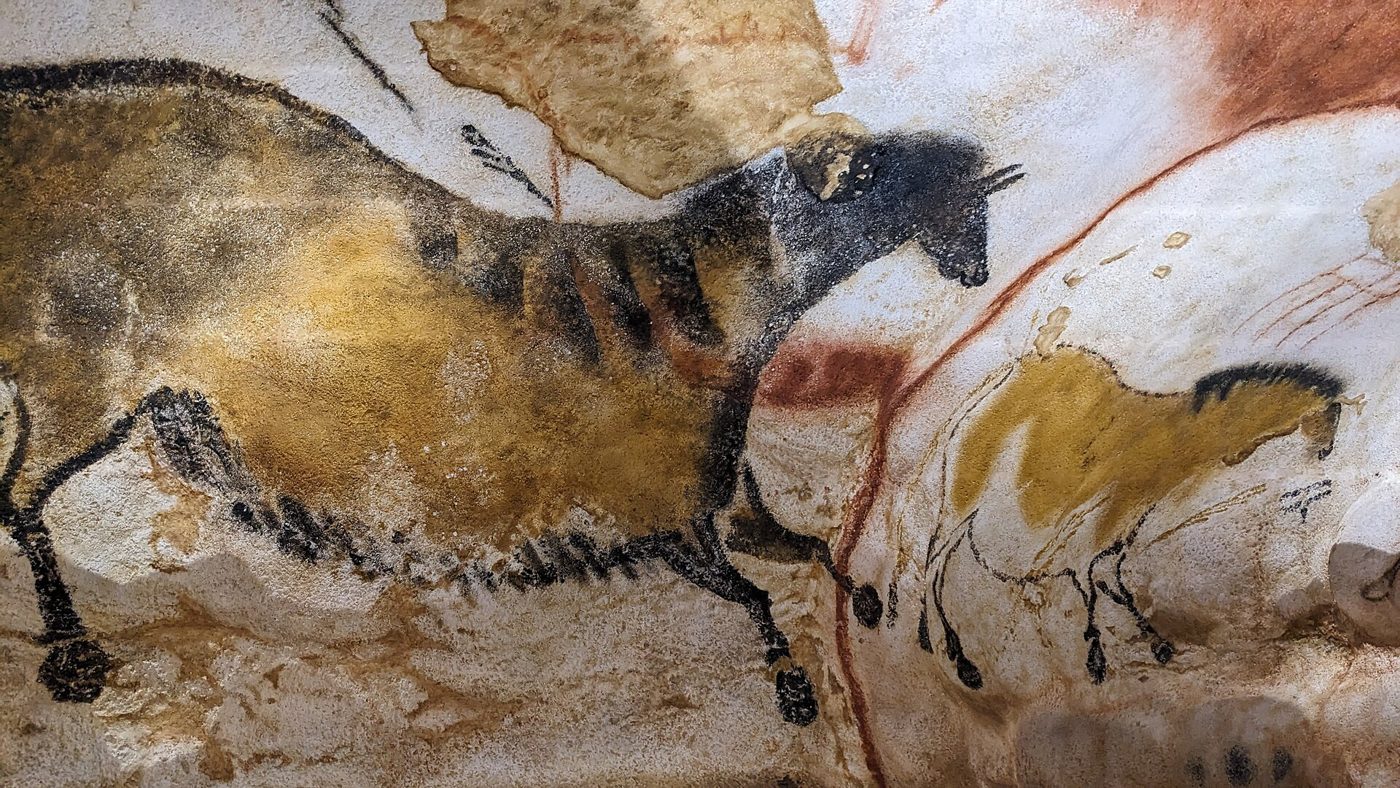
Lascaux was painted by Ice Age people before the Western Hunter-Gatherer expansion, but it shows the long tradition of hunting life they inherited.
Life in Mesolithic Europe
The world these people lived in was changing fast. As the ice melted, open tundra gave way to thick forests of birch, pine and later oak and hazel. Sea levels rose and slowly drowned Doggerland, the low plain that once joined Britain to the continent, until Britain became an island around 8,000 years ago.
They adapted with skill. They hunted red deer, wild boar and aurochs with bows and arrows tipped with tiny flint blades called microliths. They fished with traps and nets, paddled dugout canoes along rivers and coasts, and gathered hazelnuts in huge quantities. Some groups stayed for long stretches beside rich waters, leaving vast shell middens on the coasts of Denmark and Portugal.
They also left signs of a rich inner world. At Star Carr in Yorkshire, people made headdresses from red-deer skulls with the antlers still attached, about 11,000 years ago. At Lepenski Vir, in the Iron Gates gorge of the Danube, a community built trapeze-shaped houses and carved boulders into strange, fish-faced heads. What these objects meant to their makers we can only guess.
Blue eyes, dark skin: what their genomes revealed
Ancient DNA gave these people faces, and the faces surprised everyone.
- La Braña, Spain. In 2014, researchers sequenced the genome of a man buried in the mountains of northwest Spain about 7,000 years ago. He carried gene variants linked to blue eyes, but older variants at several skin-color genes, suggesting the light skin common in Europe today was not yet widespread. He also lacked the variant that lets adults digest milk.
- Loschbour, Luxembourg. The same year, a genome from an 8,000-year-old hunter became the reference for the whole group, in the study that defined Europe's three ancestral sources.
- Cheddar Man, England. Britain's oldest near-complete skeleton, about 10,000 years old, found in Gough's Cave in Somerset in 1903. His DNA, analyzed by the Natural History Museum and University College London, pointed to blue eyes, dark brown hair and dark skin.
Predicting skin color from ancient DNA is uncertain, so "probably dark-skinned" is the honest phrasing. But the pattern repeats across many Mesolithic genomes: pale eyes came first, and the variants behind lighter skin spread widely only after farmers and steppe herders arrived. As the Natural History Museum puts it, the pairings of features we expect today were never fixed.
What happened to them?
From about 6000 BCE, farmers whose ancestors came from Anatolia spread across Europe, bringing wheat, barley, cattle and sheep. The hunter-gatherers did not simply vanish. In many regions the two peoples lived side by side for centuries, sometimes more than a thousand years, and gradually mixed. A 2017 study of farmers in Hungary, Germany and Spain found that mixing with local hunter-gatherers continued over some 3,000 years, so hunter-gatherer ancestry crept upward in farming populations over time.
The story varied by place. In Britain the incoming farmers almost entirely replaced the local foragers, a story told in our guide to where Europeans come from. Around the eastern Baltic, by contrast, hunter-gatherer ways of life and ancestry held on long after farming reached the rest of Europe. Later, steppe herders added a third layer, covered in our guide to steppe ancestry.
Who carries the most Western Hunter-Gatherer ancestry today?
Everyone with European roots carries some. The broad pattern:
- Highest: the eastern Baltic, including Lithuania, Latvia and Estonia, where farmer ancestry arrived late and in smaller amounts.
- Fairly high: other parts of northern and northeastern Europe.
- Lower: southern Europe, where early-farmer ancestry dominates, with Sardinia among the lowest.
These are averages. Two people from the same country can differ noticeably, so your own share can sit above or below the typical figure for your family's homeland.
Do you carry their DNA? What a test can show
AncestryDNA, 23andMe and MyHeritage compare you with people living today, so none of them reports "hunter-gatherer" ancestry. A high "Baltic" result hints at it, but isn't a measure of it. Two clues in your raw DNA file are more direct:
- Your maternal haplogroup. Hunter-gatherer women overwhelmingly carried branches of haplogroup U, especially U5 and U4. Cheddar Man, Loschbour and La Braña all carried U5b branches. U5 is still found across Europe today and is especially common among the Sámi of northern Scandinavia. If your mother's mother's line is U5, it very likely goes back to Europe's Ice Age and Mesolithic foragers.
- Your paternal haplogroup. If you have a Y chromosome, check for haplogroup I, particularly I2. It was the dominant male line among Western Hunter-Gatherers and survived through farmers and later peoples into the present. A rarer hunter-gatherer line, C1a2, was carried by the La Braña man and still turns up in a few men in Spain. Note that many modern I2 men descend from much later expansions, so the deep origin is ancient but the route to you may be recent.
A haplogroup is one line out of thousands of ancestors. It tells you about the origin of that single line, not how much hunter-gatherer ancestry you have overall. Measuring your overall share means comparing your whole genome with ancient individuals.
Our free analyzer does the first part of that today. It compares your raw DNA file with more than 16,000 ancient individuals and shows which ancient peoples carried your maternal and paternal lineages, including Western Hunter-Gatherers where they match. It runs entirely in your browser, so your file is never uploaded. Not sure where your raw data is? See how to download it.
Already have a 23andMe, AncestryDNA or MyHeritage file? Open it in our free analyzer. It runs entirely in your browser, and your DNA is never uploaded.
Try the free analyzerHaven't tested yet? 23andMe reports both haplogroups in its standard results, and a FamilyTreeDNA test places your maternal or paternal line on a much finer branch, which matters for lines as old as U5 and I2. Not sure which fits? Take our 30-second quiz.
Frequently asked questions
Did Western Hunter-Gatherers have dark skin?
Probably. Their genomes lack most of the gene variants linked to light skin in Europeans today, and Cheddar Man and La Braña carried older variants at key skin-color genes. Predicting skin color from DNA is uncertain, so researchers describe it as likely rather than certain.
Is haplogroup U5 a hunter-gatherer lineage?
Yes. U5 is one of the oldest maternal lineages in Europe and was carried by most sampled Mesolithic hunter-gatherers, including Cheddar Man. Your branch of it can be much younger, but its roots lie with Europe's foragers.
Is haplogroup I2 from the hunter-gatherers?
Its roots are. I2 was the most common paternal line among Western Hunter-Gatherers. Many of today's I2 branches, though, spread much later, so carrying I2 doesn't mean your line stayed in one place for 10,000 years.
Who has the most hunter-gatherer DNA in Europe?
Populations of the eastern Baltic, such as Lithuanians, Latvians and Estonians, carry the highest shares of Western Hunter-Gatherer ancestry, because farming and farmer ancestry reached that region late.
Are Western Hunter-Gatherers the same as Cro-Magnons?
Not quite. "Cro-Magnon" usually means Europe's earlier Ice Age modern humans. The Western Hunter-Gatherers came later, from about 14,000 years ago, and largely replaced the gene pool of those earlier groups, though they carried some of their ancestry.
Sources
- Fu et al. 2016, "The genetic history of Ice Age Europe," Nature
- Posth et al. 2023, "Palaeogenomics of Upper Palaeolithic to Neolithic European hunter-gatherers," Nature
- Lazaridis et al. 2014, "Ancient human genomes suggest three ancestral populations for present-day Europeans," Nature
- Olalde et al. 2014, "Derived immune and ancestral pigmentation alleles in a 7,000-year-old Mesolithic European," Nature
- Lipson et al. 2017, "Parallel palaeogenomic transects reveal complex genetic history of early European farmers," Nature
- Natural History Museum, London, "Cheddar Man: Mesolithic Britain's blue-eyed boy"