 DNAtest
Who Were the Scythians? The Horse Archers of the Steppe
DNAtest360 earns a commission if you buy through links on this page.
For about seven centuries, from roughly 900 to 200 BCE, the grasslands of Eurasia belonged to riders. Greek writers called them Scythians. They shot powerful bows from the saddle, drove a Persian king out of their country without fighting a single pitched battle, and buried their chiefs beneath great earth mounds piled with gold. Ancient DNA has now shown where they came from, and it's a more tangled story than the Greeks imagined. Here's who they were, how they lived, and what their genes say about your own ancestry.
In short
- The Scythians were Iron Age horse nomads who spoke Iranian languages. Their heartland in the west was the steppe north of the Black Sea, but related cultures, the "Scythian world," stretched east to the Altai Mountains and Tuva.
- They were not one nation. Ancient DNA shows a web of related groups that mixed Bronze Age steppe herder ancestry with an East Asian component, stronger in the east, with steady contact between east and west.
- When Scythian power rose on the Black Sea steppe, new eastern ancestry arrived too. That suggests real migration, not just a spreading fashion in weapons and art.
- Most Scythian-era men tested so far carried paternal haplogroup R1a, much of it the Z93 branch. Your raw DNA file can show whether your direct lines match theirs.
Who were the Scythians?
"Scythian" is a Greek name. The Persians called similar nomads Saka, and the Assyrians wrote of the Ishkuzai. Today historians use "Scythian" in two ways: narrowly, for the people north of the Black Sea that the Greeks knew best, and broadly, for a whole family of Iron Age steppe cultures that shared a way of life, a style of weapons and a love of animal art.
Most of what we read about them comes from outsiders. The Greek historian Herodotus, writing in the 5th century BCE, devoted a whole book of his Histories to the Scythians. He described their oath ceremonies, their drinking cups made from enemies' skulls, and the felt tents where they threw hemp seeds on hot stones and "howled with pleasure" in the vapour. Some of his stories have been backed up by archaeology, including braziers holding burnt hemp seeds found in frozen Altai tombs. Others are clearly hearsay. The Scythians left no writing of their own, so their own voices are lost.
Their language survives in one place. Ossetian, spoken in the central Caucasus, descends from the speech of the Alans, a later steppe people from the same Scytho-Sarmatian family of Eastern Iranian languages.
How the Scythians lived
The Scythians were herders first. Their wealth was horses, sheep and cattle, and they moved between seasonal pastures, living in felt tents and covered wagons. Not every group was fully nomadic: some lived in large fortified settlements, and farmers in the forest-steppe of today's Ukraine lived under Scythian rule.
On the Black Sea coast they met the Greeks, who founded trading colonies there from the 7th century BCE. Grain, furs, hides and slaves flowed out to Greece, and wine, olive oil and fine metalwork flowed back. Some of the most famous Scythian treasures were made by Greek goldsmiths for Scythian patrons.
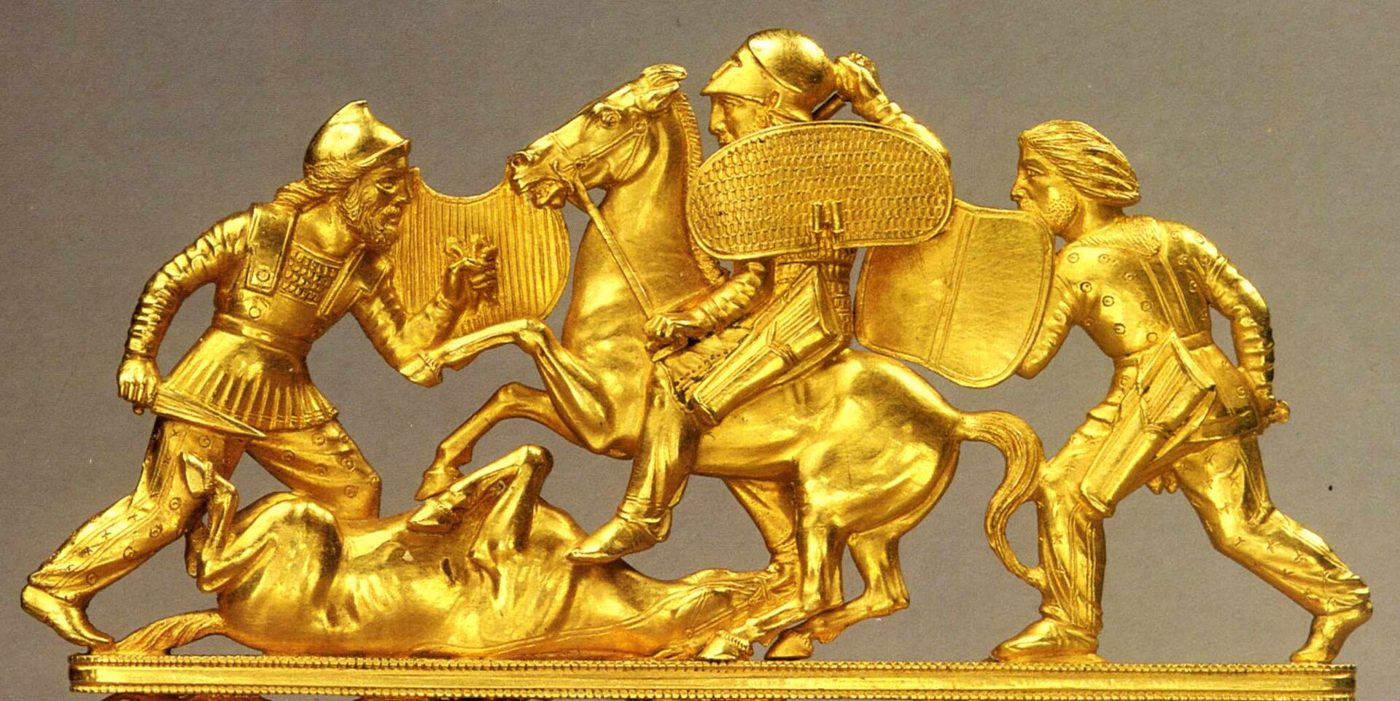
Their own art is called the animal style: stags with sweeping antlers, crouching panthers, griffins and twisting beasts locked in combat, worked in gold, bronze, wood and felt. Similar motifs turn up from Ukraine to Mongolia, one sign of how connected the steppe world was.
Warriors of the steppe
The Scythians' fame rested on the horse and the bow. Their short composite bows, made of wood, horn and sinew, were powerful enough to be deadly from a gallop, and their bronze arrowheads, often three-bladed, are found in their thousands across Eurasia. They also carried a short sword the Greeks called the akinakes, and wealthy warriors wore scale armour.
In the 7th century BCE, Scythian horsemen rode south through the Caucasus into the Near East, where Assyrian records show them as allies, enemies and mercenaries in the wars of the age. Around 513 BCE, the Persian king Darius I invaded their land north of the Black Sea. According to Herodotus, the Scythians simply retreated across the steppe, burning pastures and filling wells behind them, until the Persian army had to turn back. The details are hard to check, but the campaign clearly failed to conquer them.
Archaeologists have also found many graves of women buried with weapons, including bows, arrows and spears, across the Scythian and Sarmatian steppe. These finds likely fed the Greek legends of the Amazons. Not every woman with a weapon was a warrior, but some carried battle injuries, so it seems likely that at least some steppe women fought.
Gold, ice and kurgans
Like the Yamnaya herders three thousand years before them, the Scythians buried their elite under kurgans, earth mounds that still rise above the steppe. The royal ones are among the richest graves of the ancient world.
- Arzhan 1, in Tuva in southern Siberia, is one of the oldest royal tombs of the Scythian type, dated to about the 9th–8th century BCE. Its timber chambers held a ruler, his companions and scores of horses. Its early date, far to the east, helped shift the search for Scythian origins toward Siberia and Central Asia.
- Tovsta Mohyla, in southern Ukraine, yielded a famous gold pectoral in 1971, a great neck ornament covered with scenes of herders milking, sewing clothes and tending animals, ringed by griffins attacking horses.
- In the Altai Mountains, tombs of the Pazyryk culture, related to the Scythians, filled with ice soon after burial. The cold preserved tattooed skin, felt hangings, saddles, Chinese silk and the oldest known knotted-pile carpet, now in the Hermitage Museum. The tattooed "Ice Maiden" found on the Ukok Plateau in 1993 is one of the best-known Pazyryk burials.
From the 3rd century BCE, the Sarmatians, another Iranian-speaking nomad people from further east, took over most of the Black Sea steppe. A smaller Scythian kingdom held on in Crimea for several more centuries before it, too, disappeared.
What ancient DNA reveals about the Scythians
For a long time scholars argued about whether the Scythians came from the Black Sea region or from Siberia, and whether "Scythian culture" spread by migration or just by imitation. Ancient genomes have answered a lot of that.
- East and west were related, but separate. A 2017 study by Unterländer and colleagues looked at Iron Age nomads from both ends of the steppe. It found that Scythians in the east and west were best described as a mix of Yamnaya-related steppe ancestry and an East Asian component. Its modelling suggested the eastern and western groups had independent origins but kept exchanging genes, which may explain why their art and weapons look so alike across 3,500 km.
- No single ancestor group. A 2018 study by Krzewińska and colleagues sequenced Bronze Age herders and Iron Age Cimmerians, Scythians and Sarmatians from the Pontic-Caspian steppe. Despite clear genetic links, no group could be seen as the direct ancestor of the next. The nomads were heterogeneous, with links to the Far East and the southern Urals, and the authors pointed to the eastern Pontic-Caspian steppe as a likely source of the western nomads.
- Migration, not just fashion. A 2019 study by Järve and colleagues found that at the start of Scythian dominance on the Black Sea steppe, the local gene pool gained more Altai-related eastern ancestry. So the rise of the Scythians there involved people moving, not only ideas.
- Two gene pools in Central Asia. A 2021 study of 111 ancient people from Kazakhstan and nearby, led by Gnecchi-Ruscone, found two main Iron Age gene pools, one centred on the Altai and one on the Urals. Both formed from mixing in the Late Bronze Age, and both were later transformed when the eastern nomad empires, such as the Xiongnu and Huns, spread west in the first centuries CE.
The picture that emerges is a loose world of related peoples, not a single tribe on the march. A 2018 study of 137 ancient genomes by Damgaard and colleagues fits the same pattern across the whole steppe: Iron Age nomads, including the eastern Scythians known as the Saka, carried more East Asian ancestry than the Bronze Age herders before them. The older steppe ancestry they inherited is explained in our guides to the Yamnaya and steppe ancestry.
Do you carry Scythian DNA? What a test can show
Scythian-related ancestry was later absorbed into many peoples of eastern Europe, the Caucasus and Central Asia. If your roots are there, some of your ancestors very likely lived in the Scythian world. But no test can tell you that you descend from "the Scythians" as a people, or from any particular tribe or king. More than two thousand years separate you from them, and you descend from a huge number of people of that era.
What you can check is your haplogroups, the branches of your direct paternal and maternal lines:
- Paternal line. Most Scythian-era men whose DNA has been read belong to haplogroup R1a, much of it the Z93 branch, with a minority on other lines. Today R1a-Z93 is common in South and Central Asia, among peoples such as Tajiks and Pashtuns, and in parts of the Middle East. Our R1a guide follows that line from the steppe to India. Carrying R1a-Z93 doesn't make you Scythian, because the branch is older than they were and spread through many peoples.
- Maternal line. Scythian women carried a mix of western Eurasian maternal haplogroups, such as H, U and T, alongside East Asian ones such as C and D, especially in the east. That mix is itself a fingerprint of the steppe in the Iron Age.
AncestryDNA, 23andMe and MyHeritage compare you with people living today, so their ethnicity estimates won't mention the Scythians. To link your DNA to them, you need a comparison with ancient genomes.
Already have a 23andMe, AncestryDNA or MyHeritage file? Open it in our free analyzer. It runs entirely in your browser, and your DNA is never uploaded.
Try the free analyzerOur free analyzer does that with your raw DNA file. It compares your maternal and paternal lineages with more than 16,000 ancient individuals and shows which ancient peoples carried them, including Scythian and other Iron Age steppe nomads where they match. It runs entirely in your browser, so your file is never uploaded. Need your file? See how to download your raw DNA data.
Haven't tested yet? 23andMe reports your maternal haplogroup, plus your paternal one if you are male. To go deep into R1a and see whether you sit under Z93 or a European branch, a FamilyTreeDNA Y-DNA test goes furthest. Not sure which test fits? Take our 30-second quiz.
Frequently asked questions
Where did the Scythians come from?
Their culture seems to have begun in the east, around the Altai and Tuva, where some of the oldest royal Scythian-style tombs date to about 800 BCE. Genetically, eastern and western Scythians had partly separate roots in Bronze Age steppe herders, plus East Asian ancestry, and kept mixing with each other.
What race were the Scythians?
Race isn't a useful way to describe them. Genetically they were mixed: mostly western steppe herder ancestry, with East Asian ancestry that was stronger the further east they lived. Greek art shows them bearded and long-haired, and they spoke Iranian languages.
Are there any living descendants of the Scythians?
No living group descends from them alone, but their ancestry was absorbed into many later peoples of eastern Europe, the Caucasus and Central Asia. The Ossetians of the Caucasus still speak a language descended from the Scytho-Sarmatian family.
What haplogroup were the Scythians?
Most Scythian-era men tested so far carried Y haplogroup R1a, much of it the Z93 branch, with a minority on other lines. Their maternal haplogroups were a mix of western and eastern Eurasian lines.
Were the Scythians the same as the Cimmerians and Sarmatians?
No, but they were related steppe nomads. The Cimmerians came before them on the Black Sea steppe, and the Sarmatians replaced them there from the 3rd century BCE. DNA shows links between all three, but none was simply the ancestor of the next.
Sources
- Unterländer et al. 2017, "Ancestry and demography and descendants of Iron Age nomads of the Eurasian Steppe," Nature Communications
- Krzewińska et al. 2018, "Ancient genomes suggest the eastern Pontic-Caspian steppe as the source of western Iron Age nomads," Science Advances
- Järve et al. 2019, "Shifts in the genetic landscape of the Western Eurasian Steppe associated with the beginning and end of the Scythian dominance," Current Biology
- Gnecchi-Ruscone et al. 2021, "Ancient genomic time transect from the Central Asian Steppe unravels the history of the Scythians," Science Advances
- Damgaard et al. 2018, "137 ancient human genomes from across the Eurasian steppes," Nature
- Wikipedia, Scythians and Pazyryk culture