 DNAtest
R1a Haplogroup: From the Steppe to Scandinavia and India
DNAtest360 earns a commission if you buy through links on this page.
Few paternal lines cover as much of the map as haplogroup R1a. It is carried by around half the men of Poland, Ukraine and Belarus, by many men in Norway and Sweden, and by tens of millions of men in India, Pakistan, Afghanistan and Central Asia. That spread is no accident. Ancient DNA shows that R1a rode out of the western Eurasian steppe world about 5,000 years ago and travelled two great roads: one west and north into Europe, one east and south to the Indus and the Ganges. Here's where R1a came from, how old it is, and the ancient peoples who carried it.
In short
- R1a is a branch of the human Y-chromosome tree, passed from father to son. It is the sister of R1b; the two split during the last Ice Age, probably somewhere in northern Eurasia.
- Early R1a was carried by hunter-gatherers of eastern Europe, including a man buried in Karelia, near Lake Onega, about 8,000 years ago.
- Most R1a men today belong to one branch, R-M417, which expanded about 5,000 to 6,000 years ago. Its European half, Z283, spread with the Corded Ware people. Its Asian half, Z93, spread with the Sintashta and Andronovo herders toward Central and South Asia.
- Your raw DNA file can usually place you on R1a and often on Z283 or Z93 or deeper. It traces one line among thousands of ancestors, so it is a clue to deep roots, not a measure of your overall ancestry.
What is R1a?
Your paternal haplogroup is your direct father-to-son line, read from the Y chromosome. From time to time a small mutation appears on that chromosome and is passed to every son and grandson of the man who first carried it. Each mutation marks a new branch. (New to this? Start with What is my haplogroup?)
R1a is the branch defined by a mutation called M420. It sits inside haplogroup R1, next to its sister R1b, the most common line in western Europe. Every man in R1a shares one direct paternal ancestor who lived in the late Ice Age, perhaps 20,000 years ago or more, though age estimates based on mutation rates carry wide error ranges and nobody knows exactly where he lived.
Testing companies usually report R1a by the name of a downstream marker such as R-M17, R-M417, R-Z282 or R-Z93. Each name sits inside the one before it, like nesting dolls. The deeper the name, the more precisely it locates your line in time and place.
The first R1a men: forest hunters of the east
Before ancient DNA, the oldest history of R1a was guesswork. Now there are real graves to point to.
- Karelia, about 8,000 years ago. On Yuzhny Oleni Ostrov, an island in Lake Onega in northwestern Russia, archaeologists excavated a large Stone Age cemetery. People there were buried with elk-head carvings and strings of animal-tooth pendants. When Haak and colleagues sequenced one of the men in 2015, he carried R1a, making him one of the oldest R1a men known.
- His people. He belonged to the population geneticists call Eastern Hunter-Gatherers: elk hunters and fishers of the forests and lakes of eastern Europe, whose ancestry mixed older Siberian and western European lineages. Their descendants later mixed on the southern steppe with peoples related to Caucasus hunter-gatherers, and that blend became the herders of the Pontic-Caspian steppe.
These early R1a lines are not the ones most men carry today. Like early R1b, many of them dwindled or disappeared. The great expansion came later, from one man's branch.
The branch that took over: R-M417
Almost all R1a men alive today descend from a man who carried the mutation M417. In a 2015 study of more than 16,000 men, Underhill and colleagues dated the expansion of this branch to roughly 5,800 years ago, and found that it soon split into two great halves:
- Z283, the European line, today concentrated in eastern, central and northern Europe.
- Z93, the Asian line, today concentrated in Central Asia, Afghanistan, Pakistan and India.
The split between these two lines happened about 5,500 years ago, in a world of cattle herders, wagons and early metal on and around the western Eurasian steppe. From that starting point, the two halves of R1a went in almost opposite directions.
One surprise from ancient DNA: R1a is rare among the Yamnaya, the best-known steppe herders of about 3300 to 2600 BCE. Their men overwhelmingly carried R1b. R1a's ancestors must have lived somewhere nearby, perhaps on the forest-steppe edge, and they surface in large numbers only with the peoples who followed.
The western road: Corded Ware and the north
Soon after 2900 BCE, a new culture spread across northern and central Europe, from the Rhine to the Volga. Archaeologists name it Corded Ware after its beakers, decorated by pressing cord into wet clay. Its people were mobile herders buried singly under low mounds, men often with stone battle-axes.
Haak and colleagues found in 2015 that Corded Ware people in Germany drew about three-quarters of their ancestry from steppe herders related to the Yamnaya. They also found that Corded Ware men carried R1a. Later studies of Corded Ware graves from Germany, Poland, the Baltic and beyond have found R1a again and again, alongside some R1b and other lines. This is the moment R1a became a major European lineage.
From the Corded Ware world, different twigs of Z283 settled in different places:
- R-Z282 and its sub-branches, including Z280 and M458, are most common in Poland, Ukraine, Belarus, Russia and the Baltic. These lines later spread further with the movements of early medieval peoples, including the early Slavs, though they are thousands of years older than any Slavic language.
- R-Z284 is most common in Norway and Sweden. It is a distinctly Scandinavian twig of R1a.
In Scandinavia, R1a shares the map with I1 and R1b. A 2020 study of 442 Viking Age genomes by Margaryan and colleagues found that Viking-era men carried a mix of paternal lines, with I1, R1b and R1a all common. Some Viking traders and raiders carried R1a far from home, to Britain, Ireland and beyond (see our Viking DNA guide).
The eastern road: Sintashta, Andronovo and India
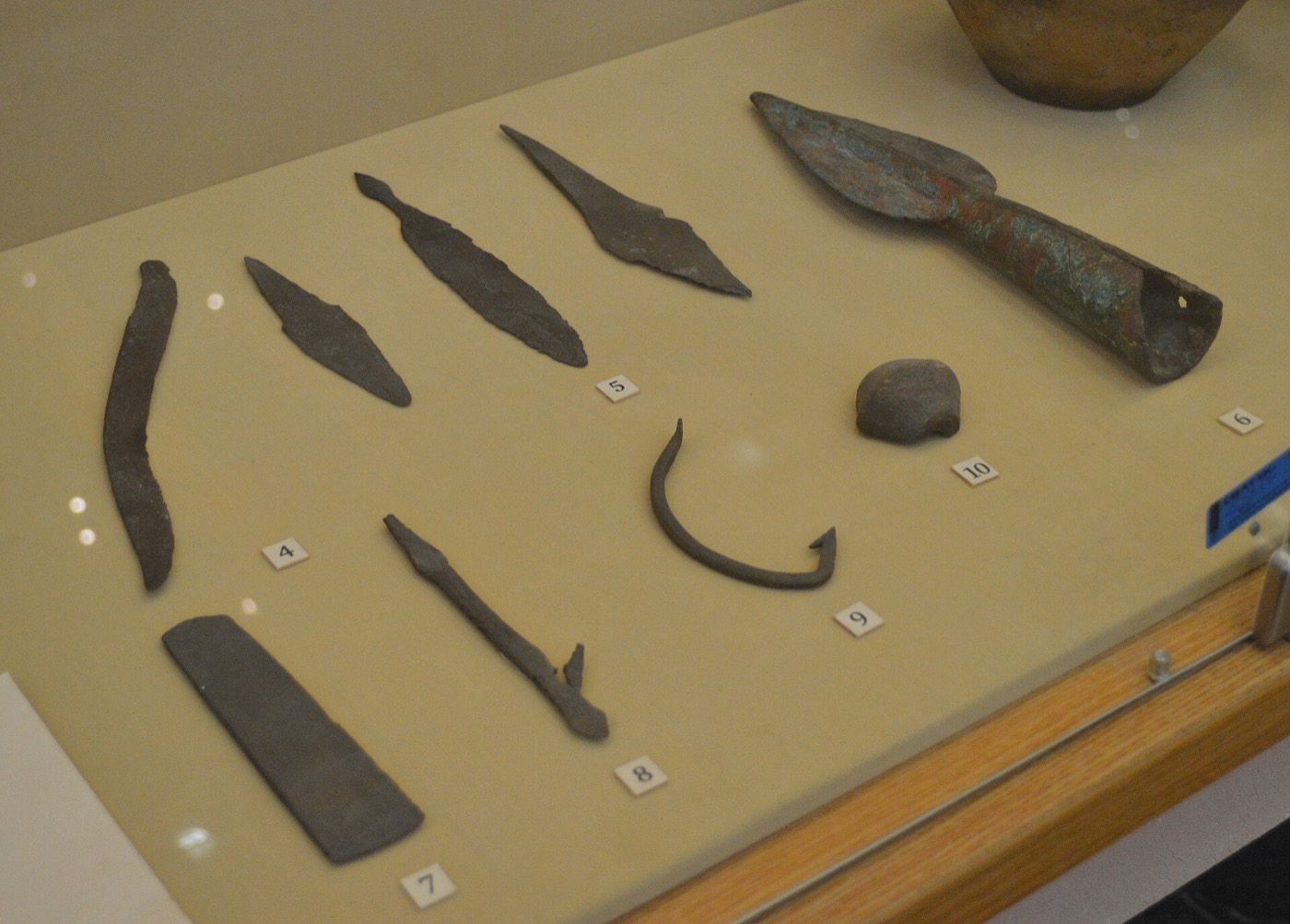
Around 2100 BCE, herders in the southern Urals began building fortified settlements ringed by walls and ditches. This is the Sintashta culture, famous for the oldest securely dated spoke-wheeled chariots, buried with warriors and pairs of horses. Allentoft and colleagues reported in 2015 that the Sintashta people were close genetic relatives of Europe's Corded Ware people, part of a movement of people back eastward toward the Urals. Their men mostly carried R1a-Z93.
Their successors, the Andronovo cultures, spread this way of life across Central Asia between about 2000 and 1150 BCE, from the Urals to the Altai. In 2019, Narasimhan and colleagues published genomes from 523 ancient people of South and Central Asia. They showed that this steppe-related ancestry moved south through Central Asia from about 4,000 years ago and reached South Asia during the second millennium BCE. In South Asia it mixed into the populations already there, and it is found today across much of the subcontinent in varying amounts.
R1a-Z93 travelled with it. Today it is one of the most common paternal lines in northern India, Pakistan and Afghanistan, and it is also frequent among Tajiks and Kyrgyz in Central Asia. Narasimhan's team reported that steppe-related ancestry is somewhat higher in some groups that traditionally preserved Sanskrit texts, which fits, though cannot prove, the long-held link between these steppe migrations and the spread of Indo-Iranian languages.
Two cautions matter here. First, the genome of a woman from Rakhigarhi, a city of the Indus Valley Civilization, carried no detectable steppe ancestry, so R1a was not part of the Harappan world before about 2000 BCE, as far as current evidence shows. Second, carrying R1a-Z93 does not make someone "Aryan," upper-caste or anything else. It is one inherited line, shared by men across many communities, languages and religions.
Later steppe peoples carried Z93 too. Many Scythian and Saka men of the Iron Age belonged to it, as did men of other Iranian-speaking herding peoples who ranged from the Black Sea to the borders of China.
Where R1a is common today
- Eastern Europe: Poland, Ukraine, Belarus, Russia, Slovakia and the Baltic states, where it is often the single most common paternal line. Mostly Z282.
- Scandinavia: especially Norway and western Sweden. Mostly Z284.
- Central Asia: notably among the Kyrgyz, Tajiks and Altaians. Mostly Z93.
- South Asia: northern and western India, Pakistan, Afghanistan and Nepal, across many caste, tribal and religious communities. Mostly Z93.
It is less common in western Europe, where R1b dominates, though Germany, Britain and the Netherlands all have significant minorities of R1a men. In the Americas and Australia it appears mainly through European and South Asian settlers.
Do you carry R1a? What a DNA test can show
Only people with a Y chromosome, usually men, carry a paternal haplogroup. A woman can learn hers by testing her father, a brother, or another man on her direct paternal line.
- Consumer tests such as 23andMe report a paternal haplogroup. Their raw files contain enough Y markers to place most men on R1a and often on Z283 or Z93, and sometimes deeper.
- Dedicated Y-DNA tests read much more of the Y chromosome and can reach branches only a few centuries old, which helps with surname research.
- What it can't show. Your Y line is one ancestor out of more than a thousand just ten generations back. R1a doesn't make you Slavic, Viking, Scythian or Indo-Aryan, and it says nothing about the rest of your family tree. It tells you which road one thread of your ancestry travelled.
Find your branch and the ancient men who shared it
If you've already tested, download your raw DNA file (here's how) and run it through our free analyzer.
Already have a 23andMe, AncestryDNA or MyHeritage file? Open it in our free analyzer. It runs entirely in your browser, and your DNA is never uploaded.
Try the free analyzerThe analyzer reads the Y-chromosome and mitochondrial markers in your file, places your branches on the YFull and PhyloTree trees, and compares them with thousands of ancient individuals. If you're R1a, your report shows which ancient people carried your branch, from Corded Ware graves in Germany to chariot burials in the Urals. It also estimates your overall steppe ancestry, which is a separate measure from your paternal line. It runs in your browser, so your DNA file is never uploaded.
Haven't tested yet? 23andMe reports your paternal haplogroup and gives you a raw file that works with our analyzer. To pin your line to a precise branch of R1a, FamilyTreeDNA's Y-DNA tests go deepest. Not sure which fits? Take our 30-second quiz.
Frequently asked questions
Where did haplogroup R1a originate?
Probably somewhere in northern Eurasia during the last Ice Age; its exact homeland is unknown. The oldest R1a men found so far were hunter-gatherers in eastern Europe, such as a man buried in Karelia about 8,000 years ago. The branch most men carry today, R-M417, expanded about 5,000 to 6,000 years ago in the steppe and forest-steppe region of eastern Europe.
Is R1a Slavic or Viking?
Neither, strictly. R1a is thousands of years older than any Slavic or Norse language. Some branches are common where those peoples lived: Z282 and M458 in Poland and eastern Europe, Z284 in Norway and Sweden. A branch can hint at where one of your lines lived, but it can't make you a member of a historical people.
Is R1a Indo-European?
R1a's spread lines up closely with the spread of steppe ancestry into Europe and South Asia, and many researchers link those migrations with Indo-European languages. But languages and Y chromosomes don't always travel together, and many Indo-European speakers carry other lines, while some R1a men speak unrelated languages. It is a strong association, not an identity.
What is the difference between R1a and R1b?
They are sister branches of haplogroup R1 that split in the Ice Age. Both later expanded with steppe-related peoples about 5,000 years ago. R1b came to dominate western Europe, while R1a became most common in eastern Europe, Scandinavia, Central Asia and South Asia.
Can a woman find out if she has R1a?
Not from her own DNA, since women don't carry a Y chromosome. She can test her father, a full brother, her father's brother or his son. Their raw DNA file, run through our analyzer, will show the family's paternal branch.
Sources
- Haak et al. 2015, "Massive migration from the steppe was a source for Indo-European languages in Europe," Nature
- Underhill et al. 2015, "The phylogenetic and geographic structure of Y-chromosome haplogroup R1a," European Journal of Human Genetics
- Allentoft et al. 2015, "Population genomics of Bronze Age Eurasia," Nature
- Narasimhan et al. 2019, "The formation of human populations in South and Central Asia," Science
- Margaryan et al. 2020, "Population genomics of the Viking world," Nature
- Wikipedia, "Haplogroup R1a"