 DNAtest
Ancient Egyptian DNA: What Mummies and Genomes Reveal
DNAtest360 earns a commission if you buy through links on this page.
For three thousand years, the people of the Nile built pyramids, carved hieroglyphs, wrapped their dead in linen and sent them into eternity with bread, beer and prayers. They left us their gods, their kings' names and their faces in paint and stone. What they did not leave, until very recently, was their DNA. Egypt's heat destroys genetic material, and for decades every attempt to read it ran into trouble. That has finally changed. Genomes from mummies in Middle Egypt, and in 2025 the first complete genome of an Egyptian from the age of the pyramids, are starting to answer an old question: who were the ancient Egyptians?
In short
- A 2017 study of mummies from Abusir el-Meleq, spanning about 1,300 years from the New Kingdom to Roman times, found these Egyptians shared more ancestry with Near Eastern peoples than present-day Egyptians do.
- The population there stayed remarkably stable through Persian, Greek and Roman rule. Present-day Egyptians carry more sub-Saharan African ancestry, much of it added in more recent times.
- In 2025, the first whole genome of an ancient Egyptian, a man buried at Nuwayrat around 2855–2570 BCE, showed mostly North African Neolithic ancestry plus about 20% from the eastern Fertile Crescent, including Mesopotamia.
- Only a handful of genomes exist so far, and none yet from the far south. A test can show resemblance to ancient Egyptians, not descent from a pharaoh.
Who were the ancient Egyptians?
Around 3100 BCE, the kingdoms of Upper Egypt in the south and Lower Egypt in the Nile Delta were united under a single king, remembered as Narmer or Menes. What held the land together was the river. Every summer the Nile flooded and left a fresh layer of black silt on the fields, so reliably that the Egyptians called their country Kemet, "the black land", after its soil.
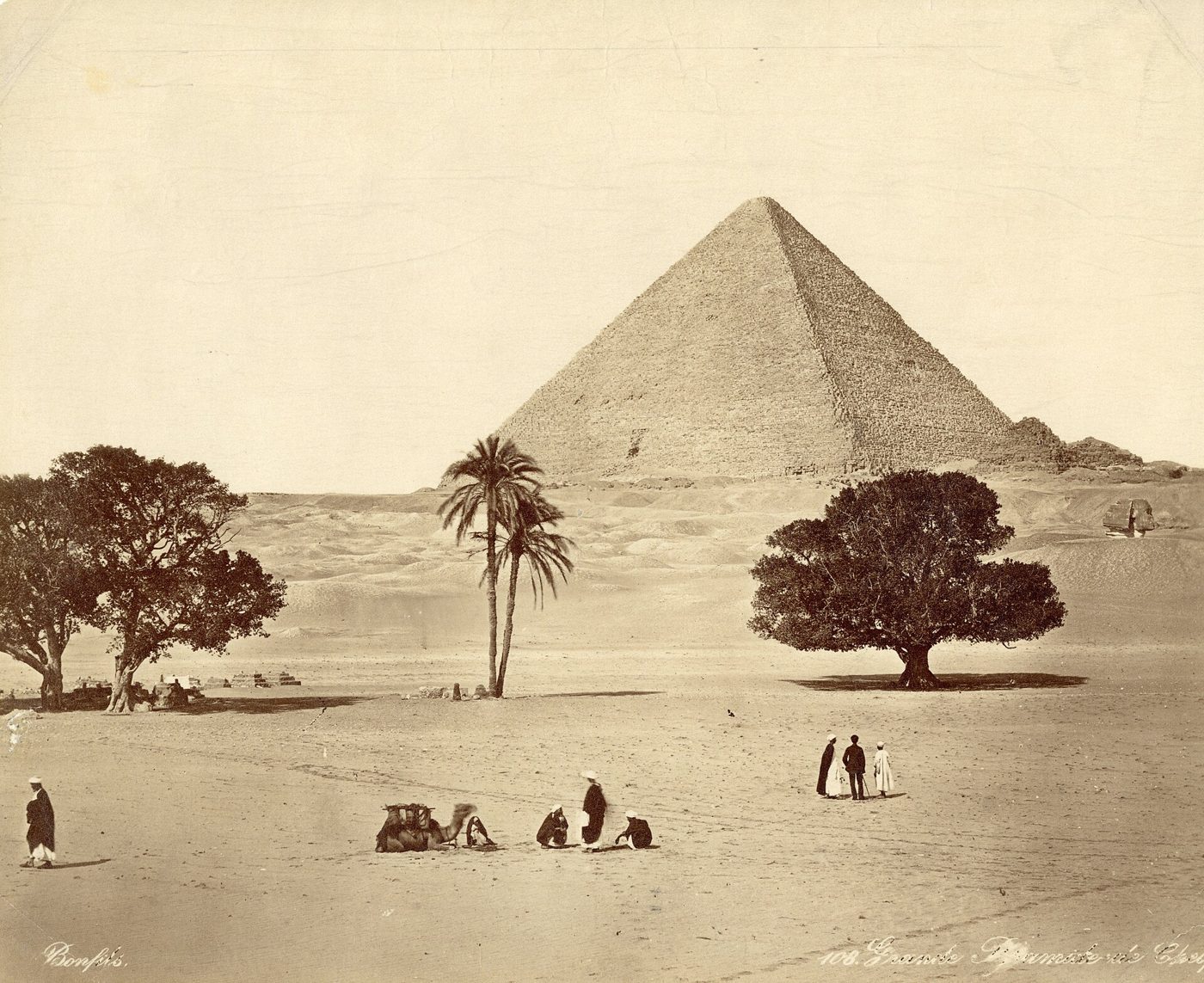
In the Old Kingdom, pharaohs built pyramids as their tombs, climaxing in Khufu's Great Pyramid at Giza around 2560 BCE. The Middle Kingdom brought a golden age of writing. The New Kingdom, from about 1550 BCE, built an empire stretching from Nubia to Syria, and the temples of Karnak, Luxor and Abu Simbel. Later, Egypt was ruled by Libyan, Nubian, Persian and finally Macedonian-Greek dynasties, the last of whom, Cleopatra VII, died in 30 BCE, when Egypt became a Roman province.
Through all of it, most Egyptians were farmers in a long, narrow strip of green between two deserts. Egypt sits at a crossroads: Africa to the south and west, the Levant and Mesopotamia to the northeast across Sinai, the Mediterranean to the north. That position is exactly what makes its genetic story interesting.
Why Egyptian DNA was so hard to read
Mummies might seem like the perfect source of ancient DNA. They are not. DNA breaks down fastest in heat, and Egypt's climate, together with the chemicals used in embalming, shatters it into tiny fragments. Early claims in the 1980s of DNA recovered from mummies were later thought likely to be contamination from modern people, a constant danger when the real ancient DNA is so scarce.
Modern ancient-DNA methods changed that. Labs now sequence the short, damaged fragments that are the signature of genuine old DNA, and they can tell those apart from modern contamination. Teeth and the dense bone of the inner ear tend to preserve DNA best. Even so, Egypt remains one of the hardest places in the world to get a genome from, which is why the evidence is still thin compared with Europe.
The mummies of Abusir el-Meleq
The first big breakthrough came in 2017. Verena Schuenemann, Alexander Peltzer, Johannes Krause, Wolfgang Haak, Stephan Schiffels and colleagues sampled 151 mummified people from Abusir el-Meleq, a town on the Nile in Middle Egypt, south of Cairo. The remains were held in museum collections in Germany. The burials spanned about 1,300 years, from the New Kingdom to the Roman period.
The team recovered complete mitochondrial genomes, the maternal line, from 90 people, and genome-wide data from three. Three findings stood out:
- A Near Eastern connection. These ancient Egyptians shared more ancestry with ancient and present-day Near Eastern peoples, especially Neolithic and Bronze Age people of the Levant, than present-day Egyptians do.
- Stability under foreign rulers. The maternal lines of people from the New Kingdom, the Ptolemaic (Greek) period and the Roman period looked highly similar. Persian, Greek and Roman rule brought new rulers and settlers to Egypt, but at this town the local population barely changed.
- A later African input. Present-day Egyptians share the same overall maternal profile, but with more African L lineages, up to about 20%, pointing to more sub-Saharan African ancestry. The authors linked this to gene flow in more recent times, such as growing travel and trade along the Nile and the trans-Saharan slave trade, which ran for some 1,250 years.
The authors were open about the limits. All the samples came from one site in Middle Egypt, and only three people had genome-wide data. Northern Egypt, closer to Sinai and the Levant, and southern Egypt, closer to Nubia, may well have differed. A population this large, along a river more than a thousand kilometres long, was never uniform.
The man in the pot: the first whole genome
In 2025, a team led by Adeline Morez Jacobs, Linus Girdland-Flink and Pontus Skoglund published the first whole genome of an ancient Egyptian. He was an adult man buried at Nuwayrat, a village near Beni Hasan about 265 km south of Cairo. His body had been placed inside a large ceramic pot in a rock-cut tomb, a burial that may have helped protect his DNA. The skeleton was excavated in the early 1900s and is held at World Museum Liverpool.
Radiocarbon dating placed him at 2855–2570 BCE, a few centuries after Egypt was unified, around the time the first pyramids were rising. The isotopes in his teeth suggest he grew up eating the wheat and barley diet typical of Egyptians, and wear on his skeleton was, in the authors' words, not inconsistent with the work of a potter. His pot burial suggests he had a higher status than most people at the site.
His genome told a two-part story:
- About 80% North African. Most of his ancestry was best matched by North African Neolithic people, the closest available reference being early farmers from Morocco.
- About 20% eastern Fertile Crescent. The rest matched ancient people from Mesopotamia and surrounding regions, similar to ancestry that spread into Anatolia and the Levant in the Neolithic and Bronze Age.
Archaeologists had long known that Egypt and Mesopotamia exchanged ideas: domestic plants and animals, the potter's wheel, perhaps even the idea of writing. This genome showed that people moved too, not just objects. One man is a tiny sample of a civilization, and the authors say clearly that many more genomes are needed. But he gives us a first direct look at the ancestry of an Egyptian from the age of the pyramid builders.
Tutankhamun and the royal mummies
The most famous DNA work on Egypt concerned its kings. In 2010, a team led by Zahi Hawass studied 11 royal mummies of the New Kingdom with CT scans and genetic markers. They proposed a family tree in which Tutankhamun's father was the mummy from tomb KV55, very likely the pharaoh Akhenaten, and his mother was the mummy known as the "Younger Lady", who was also his father's full sister. They also reported traces of malaria parasites in several mummies, including Tutankhamun.
These results made headlines, but they used short repeated genetic markers rather than full genomes, and some geneticists questioned whether genuine DNA could be read this way from royal mummies without contamination. The family relationships are widely cited, but they have not been confirmed with modern whole-genome methods.
You may also have seen claims online that Tutankhamun carried a particular paternal haplogroup, often said to be R1b. Treat these with caution: no peer-reviewed whole genome of Tutankhamun has been published, so any claim about his haplogroup rests on partial or unpublished data.
Black, white or something else? A note on an old debate
Few questions about the ancient world stir as much argument as the ancestry of the Egyptians. Modern racial categories don't map onto the ancient Nile. The Egyptians thought of themselves as Egyptians, people of Kemet, and they painted themselves, their Nubian neighbours to the south and Asiatic and Libyan peoples in distinct ways that reflected culture and politics as much as appearance.
What the genetic evidence shows so far is a people rooted in North Africa, with deep ties to the Near East, and connections to the rest of Africa that likely varied by place and time. Southern Egypt, close to Nubia, may have had stronger ties to peoples further south, but no genome-wide data from there has been published yet, so that part of the story is still open. The honest answer is that the ancient Egyptians were themselves, an African civilization at the junction of two continents.
Do you carry ancient Egyptian DNA?
If your family comes from Egypt, the answer is very likely yes. The 2017 study found that present-day Egyptians still carry the ancestry profile of the Abusir el-Meleq mummies, with additional African ancestry layered on top. Coptic Christians, whose liturgy preserves the last form of the ancient Egyptian language, and Muslim Egyptians alike descend in large part from the people of the ancient Nile. People from Sudan, Libya, the Levant and across the eastern Mediterranean may share some of the same deep North African and Near Eastern roots.
No test can prove that you descend from a particular Egyptian, and certainly not from a pharaoh. Here is what one can show:
- Ethnicity estimates. AncestryDNA, 23andMe and MyHeritage report regions such as "Egypt", "Northern Africa" or "Levant". These describe resemblance to people living there today, not to ancient Egyptians directly.
- Maternal and paternal lines. Paternal lines common in Egypt today include E1b1b (especially E-M78), J1, J2, T and G. Each is many thousands of years old and was spread well beyond Egypt, so a line can show deep roots in the region but not a link to the Egyptians themselves. See what your haplogroup means.
- Ancient genome matches. The most direct test is to compare your DNA with the actual ancient Egyptians who have been sequenced, alongside their neighbours, such as the Phoenicians and Canaanites of the Levant and the Anatolian farmers who share their Fertile Crescent ancestry. A close match shows resemblance, not descent from any one person.
Already have a raw DNA file from 23andMe, AncestryDNA, MyHeritage or FamilyTreeDNA? (Here's how to download it.) Our free analyzer compares it with thousands of ancient genomes from across Africa, Europe and Asia, and shows which ancient peoples carried your maternal and paternal lines.
Already have a 23andMe, AncestryDNA or MyHeritage file? Open it in our free analyzer. It runs entirely in your browser, and your DNA is never uploaded.
Try the free analyzerIt runs in your browser, so your DNA file is never uploaded. Haven't tested yet? For family history and finding relatives, AncestryDNA has the largest database. To pin your paternal line to a precise branch, FamilyTreeDNA's Y-DNA tests go deepest. Not sure which fits? Take our 30-second quiz.
Frequently asked questions
What did DNA from mummies reveal?
The largest study, of mummies from Abusir el-Meleq in Middle Egypt, found that ancient Egyptians there shared more ancestry with Near Eastern peoples than modern Egyptians do, and that the local population stayed stable for about 1,300 years, even under Greek and Roman rule. Present-day Egyptians carry more sub-Saharan African ancestry, added more recently.
Are modern Egyptians related to ancient Egyptians?
Yes, largely. Ancient DNA shows strong continuity between the mummies and people living in Egypt today, with extra African ancestry added over the last couple of thousand years. Later arrivals, including Arabs after the 7th century, also contributed, but the ancient population was not replaced.
What haplogroup was Tutankhamun?
No one knows for certain. No peer-reviewed full genome of Tutankhamun has been published. Claims online that he belonged to haplogroup R1b do not come from a published genome.
Can a DNA test show if I'm descended from the pharaohs?
No. After 3,000 years, any one ancient person is either the ancestor of a huge number of people or of no one alive, and DNA can't trace a single family that far back. A test can show how much your ancestry resembles ancient Egyptians and their neighbours, and which deep maternal and paternal lines you carry.
Sources
- Schuenemann et al. 2017, "Ancient Egyptian mummy genomes suggest an increase of Sub-Saharan African ancestry in post-Roman periods," Nature Communications
- Morez Jacobs et al. 2025, "Whole-genome ancestry of an Old Kingdom Egyptian," Nature
- Wikipedia, "Ancient Egypt"
- Wikipedia, "Population history of Egypt"
- Wikipedia, "Tutankhamun" (family relationships and the 2010 DNA study)
- Wikipedia, "Abusir el-Meleq"